


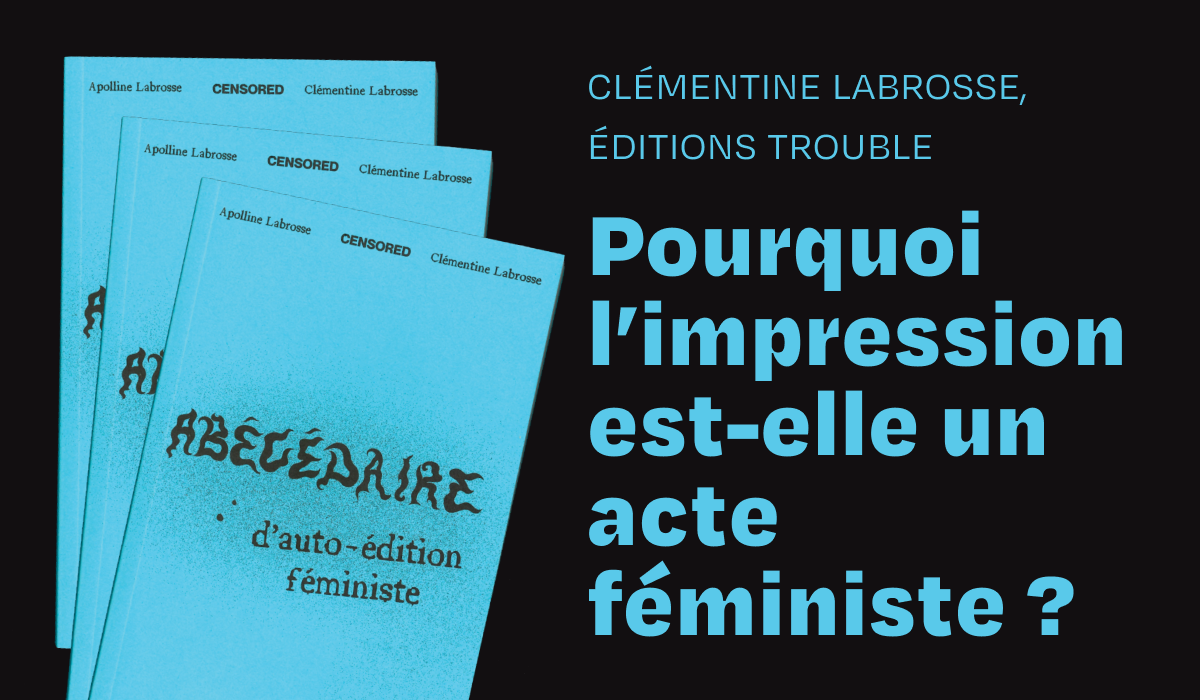
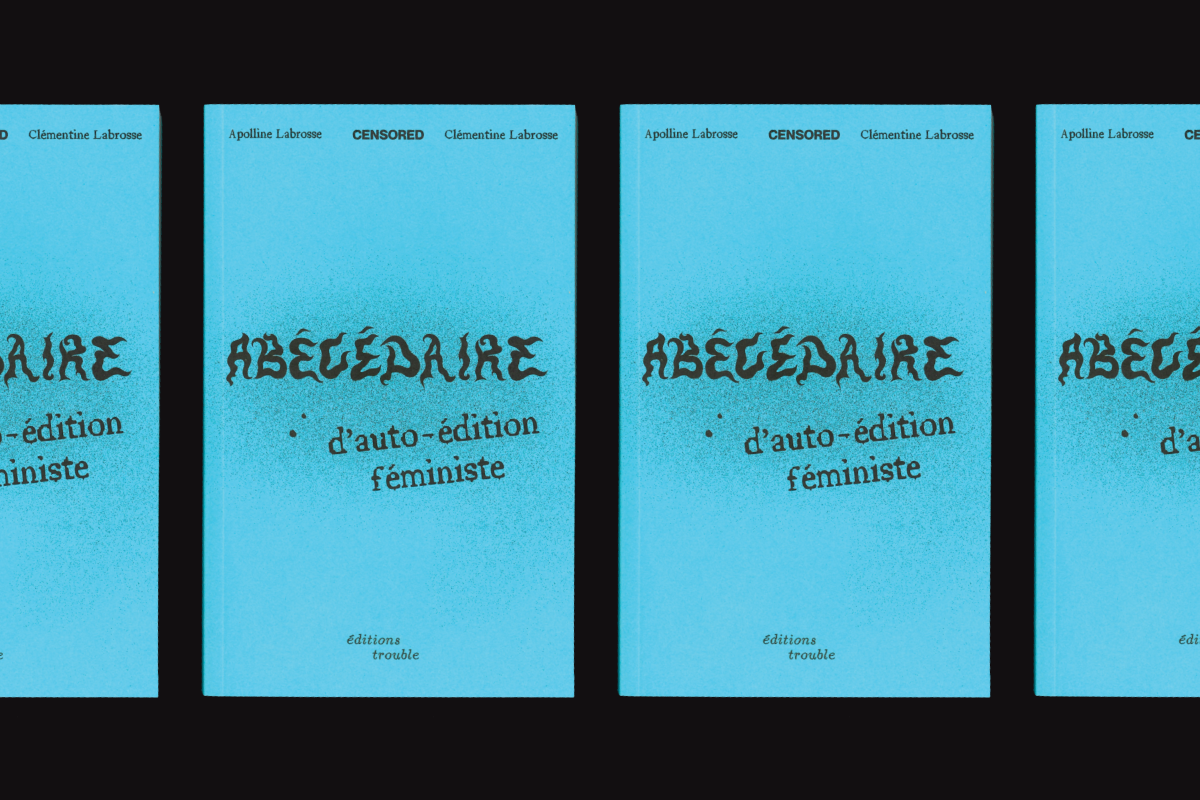
Clémentine Labrosse is editor-in-chief of the feminist journal Censored, founded in 2018 with her sister Apolline Labrosse, who oversees its artistic direction. Both are also co-founders of éditions trouble, an associative publishing house with a revolutionary spirit. Following Manifesto for a Deviant Democracy, an essay by author and journalist Costanza Spina on queer love in the face of fascism, Clémentine and Apolline Labrosse together sign the Alphabet of Feminist Self-Publishing, published on March 8, 2024. The book offers an exploration of self-publishing and its practitioners, providing tools, techniques and reflections useful to those who wish to print unconventional narratives. Running through it all is feminism as a political idea in service of people who nurture the desire to experiment, to organize, to gather and then scatter, to listen to one another and above all, to shine. In this constellation, certain stars choose paper as a medium of struggle and transmission.
What connection can be made between feminism and publishing one's writing?
Clémentine Labrosse: In history, printing by women was first a way to reclaim techniques. There's often a sense that publishing is reserved for large groups or inaccessible structures. Paper, in our collective imagination, carries an elitist dimension when in reality there's great diversity in writings and printed materials. I'm thinking particularly of leaflets and zine culture. Unfortunately, we tend to associate printing with something too big for us. The key thing is to demystify this perception. That's certainly why many feminist campaigns and information tools have gone through paper. The goal is to learn together. This process of reclaiming is naturally emancipatory. "Printing is just a pretext for meeting and creating together," emphasizes Pauline Rivière, co-founder of Ateliers du Toner [cooperative self-publishing workshops based in Brussels, ed. note]. I completely agree with this view. Feminism touches both the intimate and the political, and therefore the collective. Pooling resources means organizing to create revolution. And committing to a publication to share information is deeply liberating. There's an idea here of collective learning and building. Finally, the concept of archiving is essential. Today, with social media, one might think printing is outdated. Yet we must still ask ourselves what will remain for future generations. Whether yesterday, today or tomorrow, if we continue to print, it's to create archives of our lifetime. It's about not waiting for our narratives to be taken from us, but transmitting them ourselves, in our own way, using the forms that suit us.
You're talking about fanzine culture, which is deeply rooted in feminism. How do you explain this special connection between women and print media?
CL: Women's relationship with paper seems marked by a greater form of experimentation and internal reflection, both from a feminist and queer perspective. In our case, Costanza Spina's Manifesto for a Deviant Democracy, we designed it in a square format, printed with purple ink. Our Alphabet of Feminist Self-Publishing is admittedly more classical, but we still use striking typefaces that Apolline created herself. Paper is quite an experimental ground. It's deeply connected to the do it yourself culture where resources are within everyone's reach. It's a medium that is at once tangible, accessible and playful.
The question of archives is particularly close to your heart—you made it the theme of an issue and offer a definition of it in the Abecedary. What are the elements that keep things from falling into oblivion: the power of narratives, graphic design, what you build with the community? With Censored, how did you respond to this question?
CL: The issue on transmission was a turning point for us. It's the one that marked our renewal, since Censored has been around for five years now. It was in 2020, during lockdown, that we became aware of the need to rethink our design and editorial approach. Our first issues were ultimately not very carefully thought through in terms of marketing and editorial direction. As self-taught people, we launched blindly, following what we were used to seeing in mainstream press—that is, A4 format, covers with images on glossy paper, standard formats for articles and interviews. We said to ourselves: but why are we doing this? In reality, it was a kind of mimicry of what we knew from the press; it was a way of making fun of classic women's magazines by adopting their graphic codes. We quickly realized we wanted to experiment even more. If tomorrow, Censored should become a scroll talisman, why not. The idea is to move away from the standards taught in school, where you're often asked: "OK, what's your vision? What are your formats?" Today, we don't follow a fixed editorial line; we adapt to our mood of the moment. Our issues don't have an explicit table of contents, no summary. It's a bit mysterious, but that mystery is pleasant to cultivate. What can also distinguish us is that we don't seek to publish at all costs people who are very followed on Instagram or experts in their field. The idea is to give importance, through the print medium, to voices that might not have a place in other media.
Do we absolutely have to present powerful stories or emancipatory narratives of struggle? Does every feminist publication necessarily have to be revolutionary?
CL: Yes, I think it's important, but with nuance. It's not so much a question of quality, but rather of definition. What exactly do we mean by a "strong narrative"? If it's a recognized person who explores and shares their expertise or analysis, that's necessarily a strong narrative. But an anonymous person exploring poetry and daring to publish their work is equally powerful. We're aiming to offer a variety of content to find a kind of diversity of voices, without being confined to just anger or the expression of always very powerful narratives. It's also about showing vulnerability, gentleness. Feminism isn't just about fighting, it's also about imagination, reflection, taking up space through pages and in different formats. It's possible to devote twelve pages to something extremely contemplative. That's the blend we appreciate. Behind all this, our work as editors is to seek balance, so that our magazine sells and gets read, because not everything is commercial. We need to find a balance of formats with visuals that are appealing to the eye, narratives, and softer proposals. The essential thing is to compose the whole harmoniously.
Paper carries with it the idea of exception: if it was printed, it's because there's something significant behind it. Must the object being published absolutely be perfect?
CL: Everything doesn't have to be perfect, otherwise you'd never get anything done. In our early issues, there were spelling mistakes, design problems, things that didn't work. And actually, that's okay. Today, though, we tend toward much more rigor and precision. We try not to leave anything to chance, even though things always slip through our fingers. On one hand, there are the classical orthotypographic rules of the Imprimerie nationale that we don't necessarily master, and on the other hand, there are our own rules and creations. We need to find a compromise between the two, so as not to be too far outside the box. The idea is to show that we're aware of these standards while adapting them to our vision. Maria Tasso, our editorial secretary, also plays an essential role in this editing work. She has an amazing eye for detail. Thanks to her, the quality of our publication has improved considerably.
The question of time is crucial in publishing: it's easy to assume you need to publish quickly and keep up with current events so as not to be forgotten. For your part, you chose to slow down the frequency of Censored. Why?
CL: There are several reasons. The most pressing was burnout. We were in a state of extreme exhaustion and we realized we couldn't support ourselves any other way. Because in reality, Censored doesn't bring in any money—it's a nonprofit association project. On the side, we each have freelance assignments. The problem was we no longer had time to earn a living. Censored was taking up too much space and making our situation very precarious. Last March, we released Costanza Spina's book at the same time as « Apocalypticotrashecocidocious », the Censored issue on ecology. This double publication, combined with personal difficulties, meant we couldn't even open our computers anymore, couldn't answer emails. It convinced us it was time to step back and slow down. We still decided to publish the five-year anniversary issue of Censored, since it was already underway, and then we chose to move from biannual to annual publication. This allows us to breathe, to earn a living, to simply live. Slowing down also opens up new perspectives. We'd long wanted to create a publishing house. When we read texts by authors we admire, it makes us want their articles to become books. It's an extension of our content. It also lets us have even more fun with formats: we produce square formats, small zines. Spacing out Censored publications gives us time to publish books. There's also one last reason for the change in frequency: it's tied to our refusal to grow. We don't want to be constrained by rigid scheduling. The biannual rhythm worked at one point. That's no longer the case today. We adapt publication to our lives, our availability, our desires. Censored is a fluid project.
As a woman, a feminist, someone who is committed, is it difficult to work on a feminist project? Can a form of activist burnout set in?
CL: It's a very real issue. We often receive messages from people who send us their texts knowing they might not be selected for the next issue, but who feel the need to share them. There's a cathartic aspect to it, whether for people who've never been published before or for journalists more accustomed to traditional formats. We receive very emotional, intimate texts that appeal to traumatic memories. We take in all these narratives and it's not always easy. On the other hand, we're constantly immersed in news related to feminism and queer issues. Even when we watch a documentary, even when we read a book, it's often work-related. Today, we're trying to better define this boundary, to find a balance. That said, it's not activism, more like commitment. We're somewhat in the antechamber of struggles, set back, but not on the margins. We often say that struggle begins in the imagination.
In the book, you mention that you have the content you publish reviewed by the people involved. Why?
CL: The books we publish at trouble editions are meant to be written by queer, trans, and racialized people. So we asked ourselves who should edit these works. A striking example is Toni Morrison, whose cross-interview we republished alongside Angela Davis in the latest issue of Censored. Toni Morrison explains that she decided to join Random House, a major publishing house in the United States, because as a Black woman, she noticed that texts by Black people were poorly edited. Since editors are predominantly white, it's difficult to properly edit a text without the lived experience and adequate understanding. Taking care of a text is complex and requires immersing yourself in the author's thinking and experience. The question of editorial legitimacy is central. We are two white, cisgender women. If we want to launch a feminist publishing house, it's necessary to be aware of our own limitations. That's why we decided to call on other people. The system isn't fully in place yet, but the idea is that when we publish a book, we choose an external editor and the author also chooses a person to form a committee. In one of our upcoming books, there will be something like science fiction. So we want people with an obsession for science fiction to be able to review it, and be paid for doing so. The idea is to find people who thoroughly master the subjects, whether it's writing style, literary genre, personal experience, or identity. Bespoke, in short.
You talk extensively about places, particularly the relationships with people who manage these places or who are in these places: libraries, bookstores, fairs, festivals, event evenings. Does the strength of paper also lie in its ability to be passed on and thus to be encountered? When we struggle, is paper a means of breaking out of isolation?
CL: Printed publications are a fabulous pretext for meeting people you want to publish. Many connections happen this way. We chose to go through publishing, but it can also happen in artistic circles or other fields. With Apolline, we started as two people in our bedroom. The office was a bed. At first, we were afraid to call people, to reach out to them. Then we realized that making this magazine in our corner wasn't enough. It's only the first step for organizing ourselves among the players in this movement. We understood it was essential to know our booksellers. Today, we work closely with several independent bookstores, we're friends with Un livre et une tasse de thé, with La Régulière, and many others, even in Brussels. We also exchange with other publishers. Book fairs are times when we come together, our booths next to each other, sharing advice and experiences. By pooling our resources, we understand how to improve and do things differently. That's what creates a constellation of connections where we lift each other up.
In the book, you say precisely:
CL: In the pages of GLAD! [a journal dedicated to scientific, artistic and political work that brings together research on gender and sexualities with research on language, editor's note], I came across the word "constellation". That's exactly it. It's about weaving connections, creating joyfully revolutionary networks. The idea is to connect like stars: there are big ones, small ones, some that are far away, some that are closer, but ultimately, it creates a constellation where each one is aware of the existence of the others. The more we move forward, the more we realize that a certain type of media, which takes a "girl boss" approach, doesn't really correspond to that. I have the feeling that feminism must also find its place internally.
How do you align words with actions in managing a feminist business?
CL: For us, we chose an associative structure rather than a commercial one. We feel it's difficult to create a commercial business while organizing in a feminist way. Feminism is also anticapitalist. Even though I think it's important to use marketing codes, because it's also a way to exist in a world where patriarchy, capitalism, racism exist, these questions are all interconnected. And internally, media outlets like Manifesto XXI think deeply about their own practices: who decides, how do we listen to each other? There's also the question of centralism: why should everyone have to be in Paris? Decentralization is linked to feminist questions: by staying in Paris, we inadvertently feed a certain Parisian feminism. I believe it's possible to understand capitalist codes, including those used by neoliberal feminists, to better comprehend all these worlds without getting swept up in them completely. It's about navigating all of this while also caring for our texts and the people who write them. I think a lot about how major publishing houses, belonging for example to Vincent Bolloré, care for their authors. In an independent publishing house, you have the time. To tell traumatic things, to bring texts to life, you need to build trust with the person, create a bond. That takes time and isn't profitable.
The Feminist Publishing Collective actually published an article in Mediapart to condemn the co-opting of feminist ideas by major corporations. Do you stand with their message?
CL: Yes, we reference that article in our Alphabet. The Feminist Publishing Collective was an incredible catalyst for us. It was the first time I saw publishers from different houses come together to discuss various topics, like public funding or authors who don't necessarily think to reach out to independent publishing houses. It's also a political decision to say: "I prefer to be with an independent publishing house." This collective really sparked these conversations. What's also very important is giving space to other narratives. Taking the risk of publishing people who've never been published, or who have offset or different perspectives, is essential. We need to create these spaces in books, in bookstores, for these people.
To go further
- This way to get the Feminist Self-Publishing Alphabet published by éditions trouble.
- Release date, speakers, topics… to stay informed about news surrounding Médianes' book, Creating a Media, this way!
- Apolline Labrosse reveals all the secrets behind the original covers of the Censored magazine, which stands out for its sensory front pages, always serving the editorial line within each issue.
- Printing means paper support. What elements change from one paper type to another? What impact does this have? We present practical examples.
- We are in 61 after Patrick Drahi. All the independent micro-publications have vanished alongside the last punks. All of them? No! The fanzine still lives and is a wonderful source of inspiration for engaged magazines. We reveal the recipe for their potion to help you set yourselves apart from mainstream publications while keeping your identity intact.
- Emmanuelle Josse is cofounder of La Déferlante, an independent quarterly magazine and newsletter that just launched its publishing house. She is the guest on the third episode of the second season of Chemins, Médianes' podcast.


