


Since artificial intelligence (AI) became accessible to the general public in recent months, reactions have been divided between enthusiasm for the tool's potential and concerns about tasks disappearing in favor of machines. In the United States, local newsrooms are already using AI. Among these initiatives, one hyper-local media outlet is using it in the absence of a daily newspaper, while another wants to free up time for reporting. But newsrooms often run up against the tool's limitations and skepticism from their teams.
Across the Atlantic, David Trilling, a journalist, and Winston Chen, a data technology expert (and founder of an application for people with dyslexia), are determined to harness the potential of artificial intelligence to inform citizens who no longer have access to local news. They live in Arlington, Massachusetts, a town of 45,000 residents located just a few kilometers from Boston in the eastern United States.
The two colleagues made the following finding: it is imperative that residents be aware of the decisions that govern local life, « but all too often they lack the time to stay informed », regrets David Trilling to Médianes. Another obstacle is that local meetings, municipal and community councils, school meetings and sports committees often last several hours and take up time for local journalists.
Fighting information deserts
Last August, they launched their project called Inside Arlington (a free hyperlocal news site powered by AI). Since the pandemic, the city has been streaming all its local meetings on its YouTube channel. "Without that, it's clear our project wouldn't be possible," acknowledges David Trilling.
To do this, Inside Arlington paid for a license to Antropic.AI software, one of Open AI's main competitors (which developed ChatGPT). Then David Trilling reviews the text generated by AI: "I add a few contextual words, I correct factual errors sometimes, but especially the style and typos in the names of people mentioned".
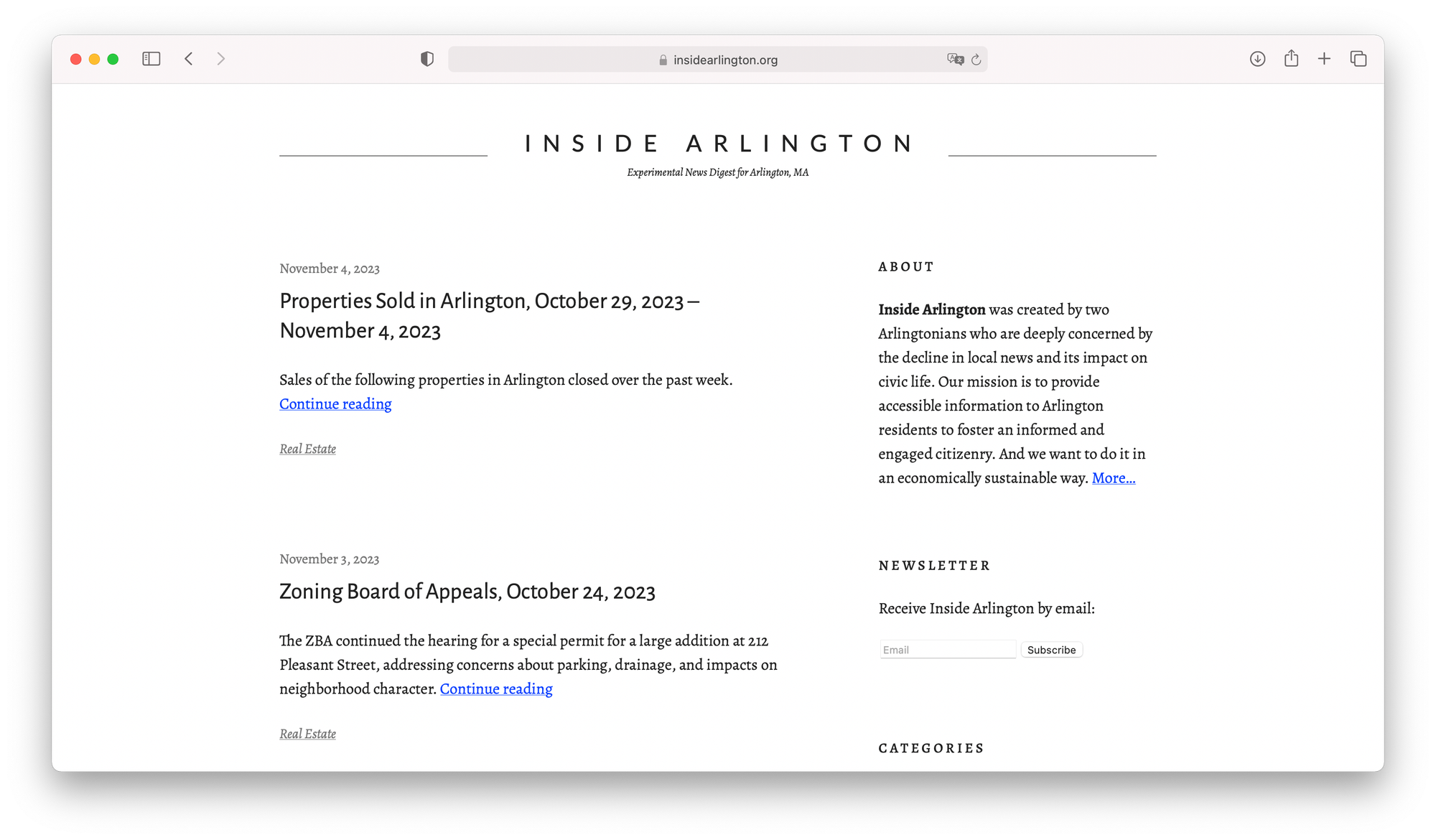
The idea is to extract audio from videos and ask AI to provide a summary in a few paragraphs of the decisions made during the meeting, in a concise and clear manner. An AI also monitors videos and regularly analyzes websites for the latest local information, while keeping track of the latest police reports.
Thus, readers quickly gain access to municipal deliberations, real estate listings, and the latest local police reports. Beyond the use of AI, the idea behind this project is "to ensure that citizens are more engaged and increase their involvement in local life. And that starts with being aware of what's happening", explains the cofounder.
David Trilling and Winston Chen generate no revenue from Inside Arlington , which reaches around 100 readers per article. Their goal now is to work with other local newsrooms and raise awareness about ethical and strategic AI use through their Nano Media company.
The founders don't see Inside Arlington as a new competitor to the local press. "Besides, Arlington doesn't have a local daily newspaper, only a weekly and a blog," laments David Trilling. The city is one of these information deserts that are multiplying across the United States and now affect one in five residents.
Indeed, roughly 2,500 American newsrooms have shut down, representing a quarter of all newspapers since 2005. Most are located in suburbs and small towns, according to a report published in 2022 by Northwestern University's journalism school.
Free up time for the report
By coincidence or not, a city with the same name also has its local newspaper using AI: Arlington, but this time in the state of Virginia. Scott Brodbeck is the founder of Local News Now, which encompasses three local news websites (ARL Now, FFX Now and ALX Now) and seven journalists. Last April, ARL Now announced that its newsletter would henceforth be written and sent using GPT-4 (the latest version of ChatGPT) specifying: "Apart from the headlines, the introductions and article summaries are all written by the GPT-4 generative AI model. The email design was primarily coded by GPT-4, and its creation and sending require no human intervention. The idea is to give readers an alternative morning newsletter to our afternoon one without needing to use additional human resources".
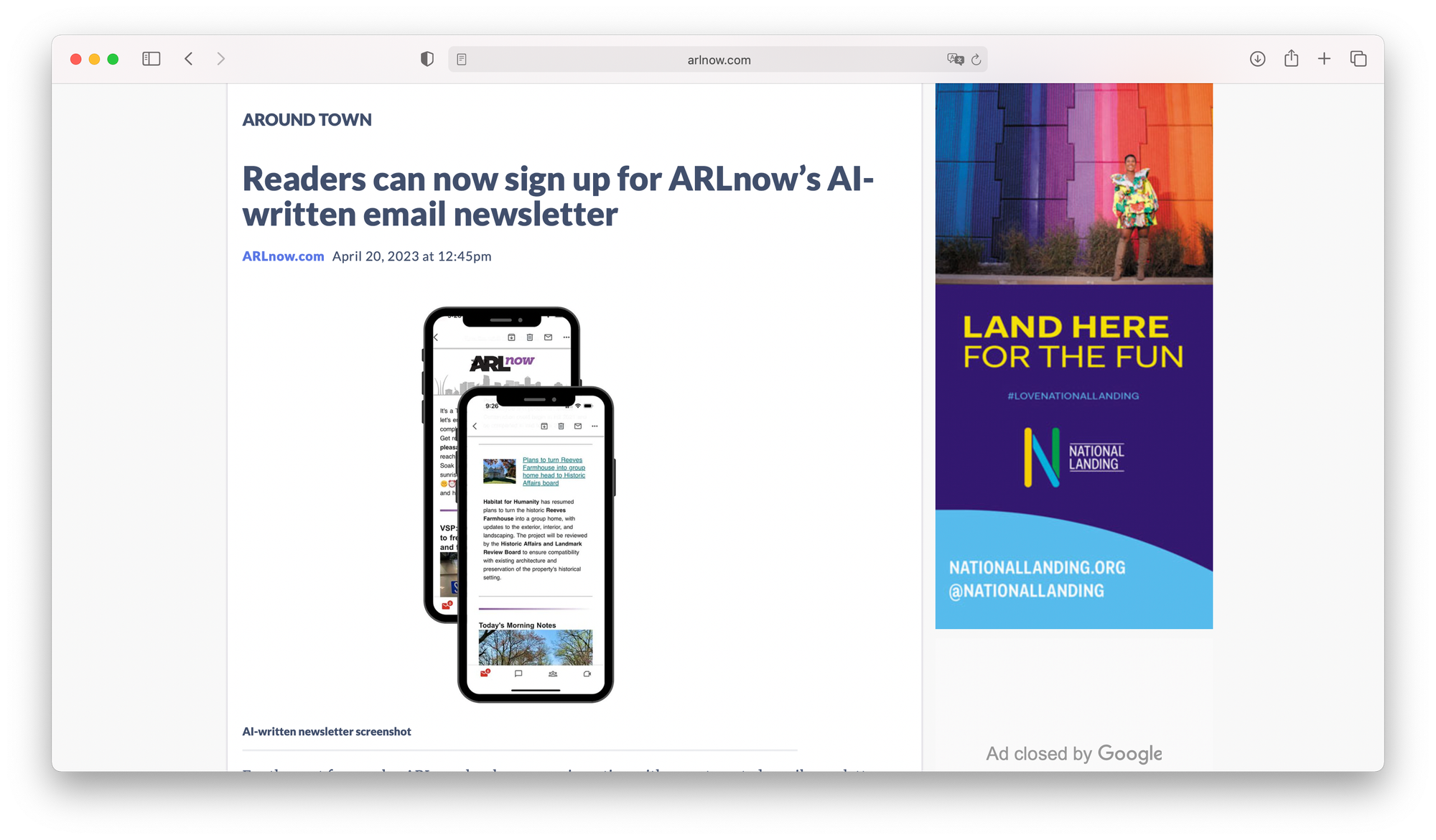
Before noting that this isn't perfect […] AI-written texts lack factual nuance […] AI-written introductions are, for lack of a better word, dated. They're also somewhat repetitive. And to emphasize that it all remains experimental.
This isn't the only use of AI for ARL Now. Scott Brodbeck has also experimented with it for LinkedIn posts, to review and correct spelling errors in articles, or even to write sponsored content. "All these tasks take up journalists' time, and prevent them from focusing more on reporting," he argues.
For Scott Brodbeck, AI also makes it possible to move toward a certain objectivity. « Text written by AI makes it possible to get closer to a writing style similar to that of Axios for example ». For now, behind Axios are indeed journalists.
AI applications in local news are multiplying
Last July, OpenAI (the company behind ChatGPT) and the American Journalism Project (which aims to provide financial support to nonprofit news organizations, support newsrooms, and launch new media outlets) partnered together. The two entities signed an agreement worth 5 million euros with the goal of "exploring how artificial intelligence development can support local journalism in innovative ways," the two organizations said.
That said, Sarabeth Berman, CEO of the American Journalism Project (AJP), sought to reassure in the same statement: "We aim to promote means that allow AI to improve – rather than jeopardize – journalism".
This partnership notably takes the form of direct subsidies to ten local media outlets supported by the AJP to help them explore AI capabilities. Additionally, the AJP acts as a kind of control team tasked with evaluating AI applications in local news in order to adjust to journalists' needs.
Newsrooms are running into AI's limits
In Ohio, the local newspaper Richland Source uses AI to report sports results from the state's elementary schools. The software used is the controversial Lede.AI and developed by the newspaper itself.
The very same one that major American press group Gannett stopped using last August. The company suspended its use after several errors slipped into the sports dispatches of the Columbus Dispatch. The articles were repetitive and lacked key details. It appears the AI knew nothing about the sport it was supposed to write about, unlike a sports journalist. Gannett therefore paused the use of Lede.AI for all local media outlets that were using it.
Ganett's latest news still concerns AI. Journalists from Reviewed, a Ganett-owned publication, have called out the fact that articles in the "Products" section were written by AI without being informed. Claims denied by the group itself.
Another concern about AI is the risk of misinformation. In work conducted by the anti-misinformation organization NewsGuard and regularly updated, 528 unreliable news sites generated by AI have been identified.
AI to improve access to information
That said, it would be futile to see AI only as a threat to local journalism and a machine for spreading misinformation.
As part of NYU Media Lab's AI & Local News Initiative, the Knight Foundation funded four programs involving AI and local news this year. For example, WNYC, New York's public radio station, which records over two million visitors each month, faced a major challenge: live video broadcasts were not accessible to deaf audiences. The station therefore developed its own real-time transcription software, all powered by AI.
Another supported project: Chequeado, a nonprofit organization fighting misinformation in Spanish-language news in the United States. Its Factchequeado site operates using its AI program called Monitorio which monitors false information in real time circulating on social media and alerts journalists so they can spend less time searching for it.
Or again, the Newsroom AI team, which wants to push even further and hopes that its AI software will automate a certain number of journalistic tasks: transcription and information organization, image and headline generation, SEO optimization. Does this signal the end of editorial secretaries in newspapers?
In France at least, the AI machine is running in newsrooms. The Ebra group announced in October 2023 that it wanted to launch a trial within the Est Républicain and Vosges Matin: editorial secretaries could use ChatGPT to review and correct articles from press correspondents. The National Union of Journalists (SNJ) promptly expressed its opposition: "The SNJ will not hand over the keys to information to computers! This must be the subject of consensus, an agreement that includes safeguards and lines that cannot be crossed ". But on October 26, Ebra backtracked after a meeting with the unions and suspended the project indefinitely.
What to pay attention to
For David Trilling of Inside Arlington and Scott Brodbeck of Local News Now, one thing is clear: AI will not save local journalism.
" AI is above all a tool to help journalists," emphasizes David Trilling. "It frees up time for reporting, argues Scott Brodbeck, and it's also a significant resource in terms of budget for newsrooms with limited means."
"The most important thing in the face of an unprecedented crisis in local journalism in the United States is to find ways to diversify revenue sources," continues the founder of Local News Now.
Addressing a local newsroom looking to implement artificial intelligence, David Trilling alerts on several points: openness to different uses of this tool and adapting its use according to needs, transparency and education for journalists and readers, testing to identify the strengths and weaknesses of AI use.
Scott Brodbeck (founder of Local News Now) emphasizes the ethical aspect. "It's necessary to always verify the sources used by AI to avoid the risk of plagiarism." He's referring notably to authors who denounced their texts being used by ChatGPT without authorization. To prevent this, French newsrooms like Radio France and the New York Times temporarily suspended OpenAI to avoid unauthorized appropriation of their content.
Finally, David Trilling and Scott Brodbeck agree on one point: any media outlet that refuses to ride the "AI wave" is heading for failure because this wave will only gain momentum in the coming months and years. It seems necessary for media outlets to fully grasp it, learn to work with it, and take time to think about ethical and deontological safeguards within newsrooms, to discuss it with journalists and readers.
Learn more
- The democratization of artificial intelligence through tools like ChatGPT has prompted the press to respond. How can we embrace this new toolkit without compromising information quality? Format, approach, debates, tools: an overview of current uses.
- Artificial intelligence can be frightening for some readers. Heidi.news took an educational approach by publishing results of articles written by ChatGPT and even engaged its readers by asking for their opinion following publication of the article.
- A newsroom wishing to introduce artificial intelligence faces new ethical and practical questions. To fulfill these missions, the New York Times decided to hire AI ethics officers within the newspaper.
- On the ethics side, many newsrooms are drafting charters for artificial intelligence use. A few examples from 21 newsrooms that have defined their own policies.
- Written transcriptions of videos, news alert notifications, or even automation of municipal council minutes—the Associated Press published results of different uses of AI within local newsrooms.


