


What does a newsroom look like? At first glance, you might imagine an action scene in which busy journalists rush from one end of an open office to the other, phone in hand under the watchful eye of wall clocks displaying ever-imminent deadlines. In many ways, the reality is more akin to a scene from Office Hijinks than to All the President's Men.
1. In videos intended for social media
Explaining how a newsroom actually works makes journalists more human and closer to their audience, beyond simply deconstructing stereotypes. With this in mind, franceinfo, from the Radio France group, chose to launch a series of short videos called "Behind the Scenes of the News". Each one aims to present a service, a profession, a news segment.
The first in this series reveals behind-the-scenes footage of how Jérôme Chapuis and Salhia Brakhlia prepare their morning broadcast. First observation: the atmosphere is rather calm. « Everyone working on this time slot arrives at 3 a.m., explains Margaux Samuel, Communications Manager at franceinfo, who initiated these videos. It's nighttime, the lights are dimmed and conversations happen quietly. » Above all, nobody rushes. « You can't go on air out of breath, so we walk, even if we're worried about being late getting to the studio. »
The videos don't just feature star journalists—the aim is to show the entire team that makes it possible for news to reach the public: the broadcast technicians, the programmers, the desk journalists… "The idea is that everyone can see themselves in it," notes Margaux Samuel. We want to demystify how we work for the general public. Even in terms of editing, we try to do something straightforward, quite raw, that shows exchanges as they really are. "
One might think that a group like Radio France would prefer not to tarnish its glamorous image with the general public. Yet the project quickly got off the ground, notes Margaux Samuel. « All we needed to do was have the idea validated by Jean-Philippe Baille, director of franceinfo. Then it was the turn of the group's leadership to give their approval. Everything moved very quickly given that there is a public service interest in launching this type of initiative. »
2. In the privacy of a private group
In smaller structures, projects of this kind are often less produced, more collaborative. Since June 17, the rap specialist review Mosaïque has been testing distribution channels on Instagram to tell its behind-the-scenes story. Called "MOSA'VIP", the channel aims to bring the review to life from within. From newsletter preparations to coffee breaks to exclusives on the magazine's next cover, the founders of Mosaïque, Lise Lacombe and Thibaud Hue, also use this space to share cultural recommendations based on their personal tastes: which concert to attend tonight? Where to celebrate Music Day? And July 14?
More spontaneous and less complicated to produce than an Instagram story or post, these messages can be sent at any time and help build reader loyalty by giving them behind-the-scenes access to the magazine. Because it fosters an intimate feel, the channel offers the media a new way to bring its content to life. « We've already shared photos of our faces, which lets people say "Oh OK, so that's them!" The channel creates attachment », notes Lise Lacombe, co-founder of the publication.
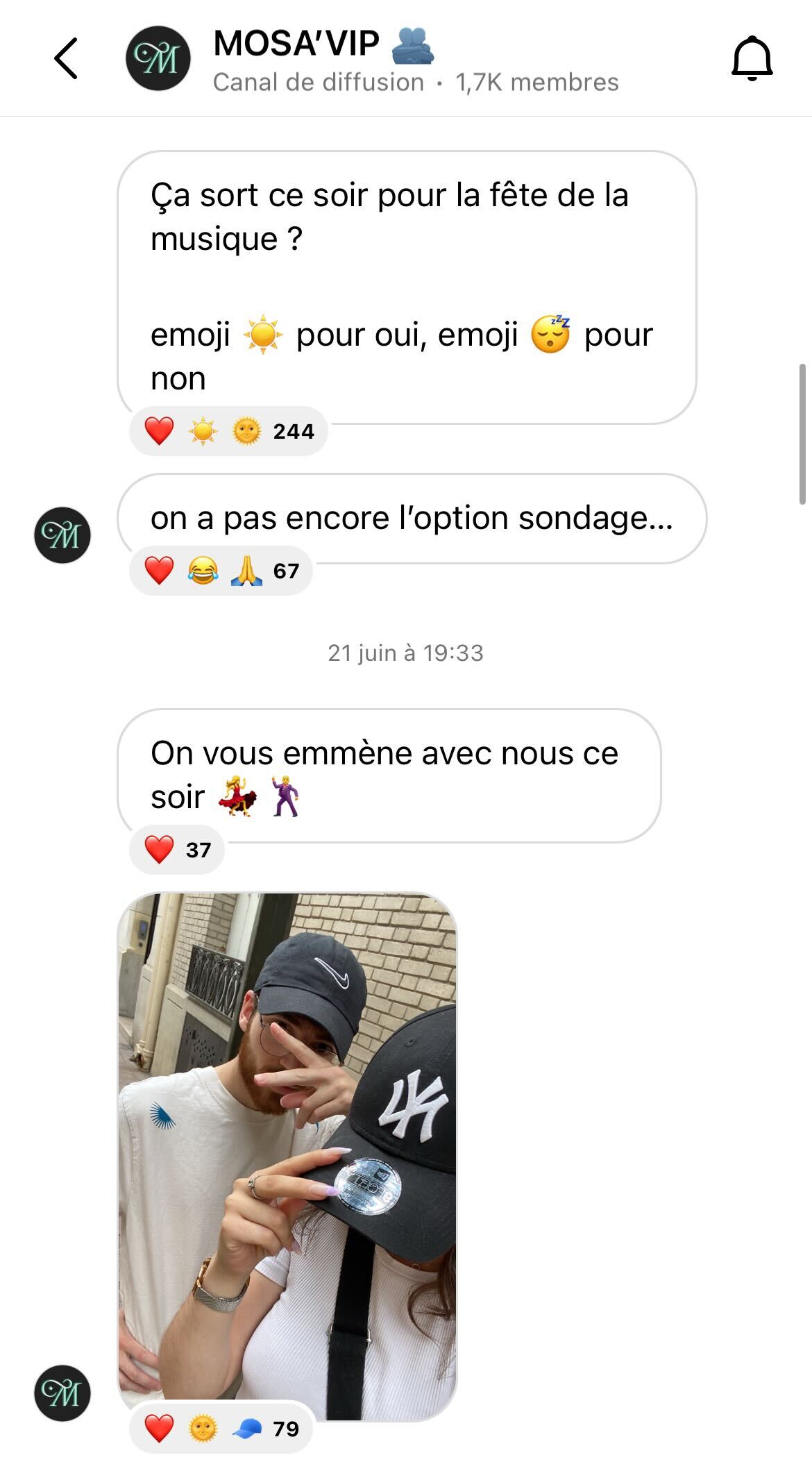
The magazine currently has 1,700 members in its channel for 13,100 followers on Instagram. « It's the right balance, comments Lise Lacombe. We never really promote the channel much because we don't want to end up with 10,000 people. It would lose its appeal. » For the magazine's « true » fans, the private group even has surprises in store. Sometimes the artists featured on the cover of the latest issue are invited to join the channel and share photos or voice messages with the community.
For Mosaïque, behind-the-scenes storytelling became part of the magazine's value proposition right from the start. "We did it very naturally from the beginning through stories, on Twitter or via our newsletter. This lets people understand what they're buying, says Lise Lacombe. Behind this 17-euro magazine is an independent team of passionate people who print in France. All the daily anecdotes we share help people see the work we're doing. "
3. In the conviviality of a live Twitch
Do you find it too burdensome to dole out anecdotes bit by bit? A good option might be to set up regular appointments with your audience. On the side of the media criticism site Arrêt sur images, the team shares the newsroom's day-to-day life once a month during a Q&A session broadcast on Twitch and republished on the site. It's an opportunity for journalists to answer all questions about their work, and for managers to explain how the newsroom operates internally.
In these live streams, everyone has a place around the table. "Paul Aveline and Nassira el Moaddem [respectively Editor-in-Chief of the site and independent journalist presenting certain episodes of Arrêt sur images, Editor's note] regularly present shows and are already well-known to our audience. On the other hand, we see less of Adèle, our documentalist. The idea is to allow everyone to introduce themselves and answer questions from our viewers," describes Sophie Roncetto, Head of Marketing and Communications and host of the monthly FAQ at Arrêt sur images.
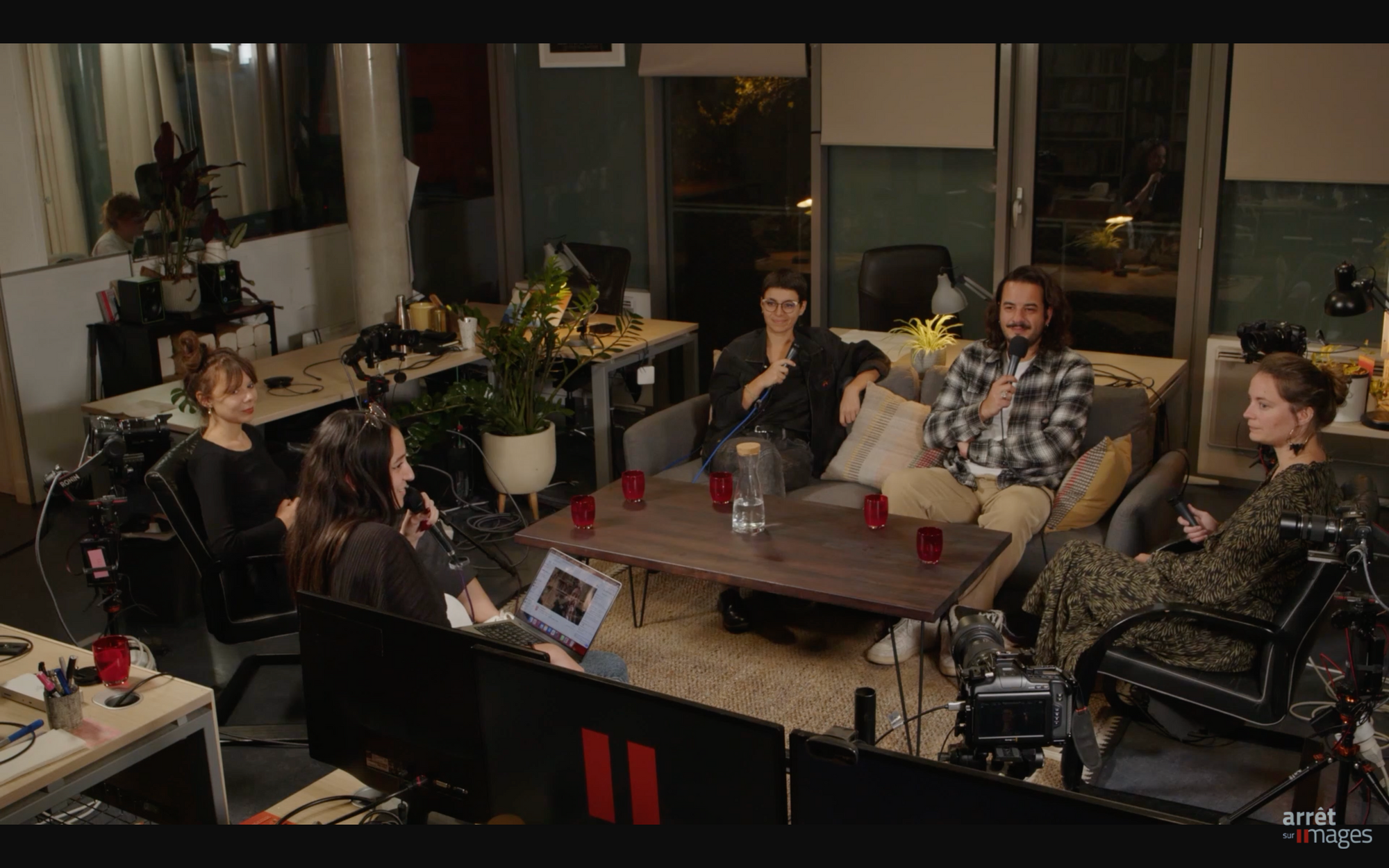
The idea emerged when the team noticed that the same questions kept coming up in the site's comments section. What is the business model of Arrêt sur images? What relationship does the editorial team have with Daniel Schneidermann, the media's founder who launched it in 2007, stepped down to the next generation in 2022 but continues to write columns on the site? Why do certain columns suddenly stop? This transparency creates a desire to learn more about how the media operates and to open up announcements about media-related updates. Readers don't hesitate, during live sessions, to ask specific questions about journalist recruitment, possible disagreements within the team, and their relationships with certain media outlets in particular.
On the organizational side, the first two FAQs (700 viewers for the first one, 250 for the second one) were conducted with the entire editorial team. A rotation system made it possible to share the floor, with part of the team present during the first hour before handing over to their colleagues in the second half. The next ones should be more thematic, with only the relevant (and willing) team members around the table.
Donations, which can be enabled on the Twitch platform, are not available for Arrêt sur images broadcasts. "We have many subscribers who don't like Twitch and on our side, we also didn't want to give money to this platform. So we redirect subscribers to us, on the platform we usually use for donations", explains Sophie Roncetto. This wariness toward Twitch also explains why the media needs to post the replay on its site and ask its readers in advance if they have questions to ask the editorial team. These are collected on social networks and in the comments section of the site.
Sophie Roncetto's advice to anyone who would like to launch a similar format on Twitch: "Don't overthink it. At first, I saw it as something very formal because of the cameras and the studio setup. But it's a very relaxed format, and it's okay to have awkward silences, to stumble over words, to tell a joke that falls flat. On Twitch, viewers are particularly kind and supportive."
To go further
- Media outlets are entrepreneurial projects that sometimes struggle to communicate about themselves. Yet it's a matter of public interest and an important marketing lever. Booska‑P, Les Jours, and Gimlet are revealing their behind-the-scenes operations, and this formula works.
- Elections, cryptocurrencies, geopolitics… These are subjects that require nuance and time, areas where social media formats aren't always suited. To build and retain community trust, some media outlets are betting on embodying their brand through a single personality.
- In the face of distrust comes transparency. From "About Us" pages to journalists' interest declarations, to sharing their working methods, newsrooms are laying their cards on the table with their audience. A show of trust rewarded by the attention of readers who want clearer, more direct information.
- How can you turn transparency into an asset in your model? Valentin Levetti, cofounder of the YouTube and Twitch channels Stupid Economics, answers our questions in this episode of our podcast Chemins.


