


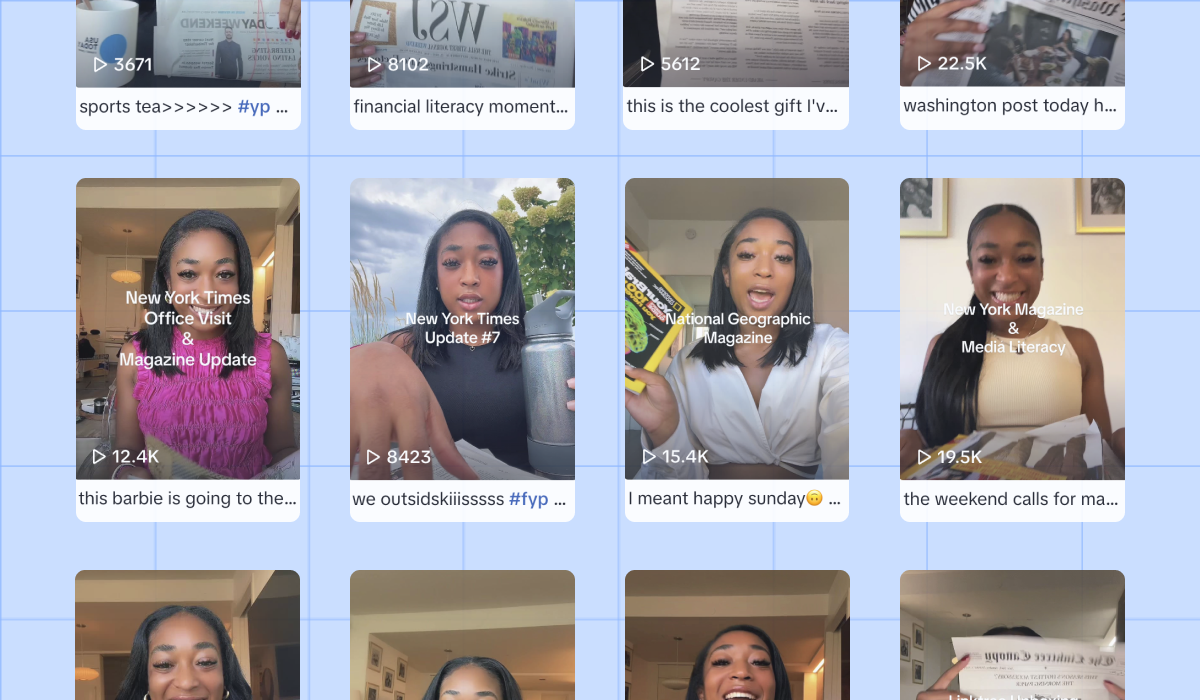
Between spoonfuls of cereal, Kelsey Russell reviews the week's news. "Happy Thursday! Today it's the New York Times," she announces proudly to the camera, waving the printed edition of the American newspaper in one hand. A ritual she repeats almost every day, for several weeks now. At breakfast, at the airport, or in her bathroom, this 23-year-old American sociology student pulls out her newspaper, carefully annotated with highlighter marks, and comments on the news for her community.
« I want Gen Z to take back control of how it consumes information » she declares in one of her videos. Her initiative has resonated with an audience that, study after study, expresses a growing disenchantment with the press and a loss of trust in the media.
Her first video on the subject, published in late August, has already racked up 1.7 million views, and comments from her followers would make major media marketing teams green with envy: " The newspaper looks more interesting than anything I've read on the internet over the past 5 years "; " Okay, you got me, I'm going to start reading the print newspaper " or even " In journalism circles, we try to find ways to get people interested in the news again, and she just saved journalism with a 30-second video ".
A success that was quickly noticed, even beyond the Atlantic. « I saw tweets and articles passing by in French about my TikToks, but my French isn't very good » she admits with a laugh as we begin our late-night conversation on Google Meet, time zones being what they are. Pleased with the media attention her work is receiving, she hopes to see a movement emerge that will go far beyond her videos.
An unexpected success
Kelsey maintains an ambivalent relationship with journalism, she recalls. As a younger woman, American journalist and lawyer Star Jones was among her greatest inspirations. "I loved the fact that someone could take a very complex concept, like law, and manage to make it accessible to the general public". While considering a career in television, she enrolled in a short journalism course offered by her school, Westminster Schools, located in Atlanta. "But when I understood what it involved, the writing style and everything else, I realized it wasn't for me [...] But I've always kept this passion for media and the ability to communicate ideas".
It's only recently that her interest in the subject has been renewed. In a video published in August, she happily announces having finally received the only gift she wanted for her birthday: a printed edition of the New York Times. "I wanted to learn more," she explains, "I wanted to level up and I thought that a print newspaper would be a good way to do that."
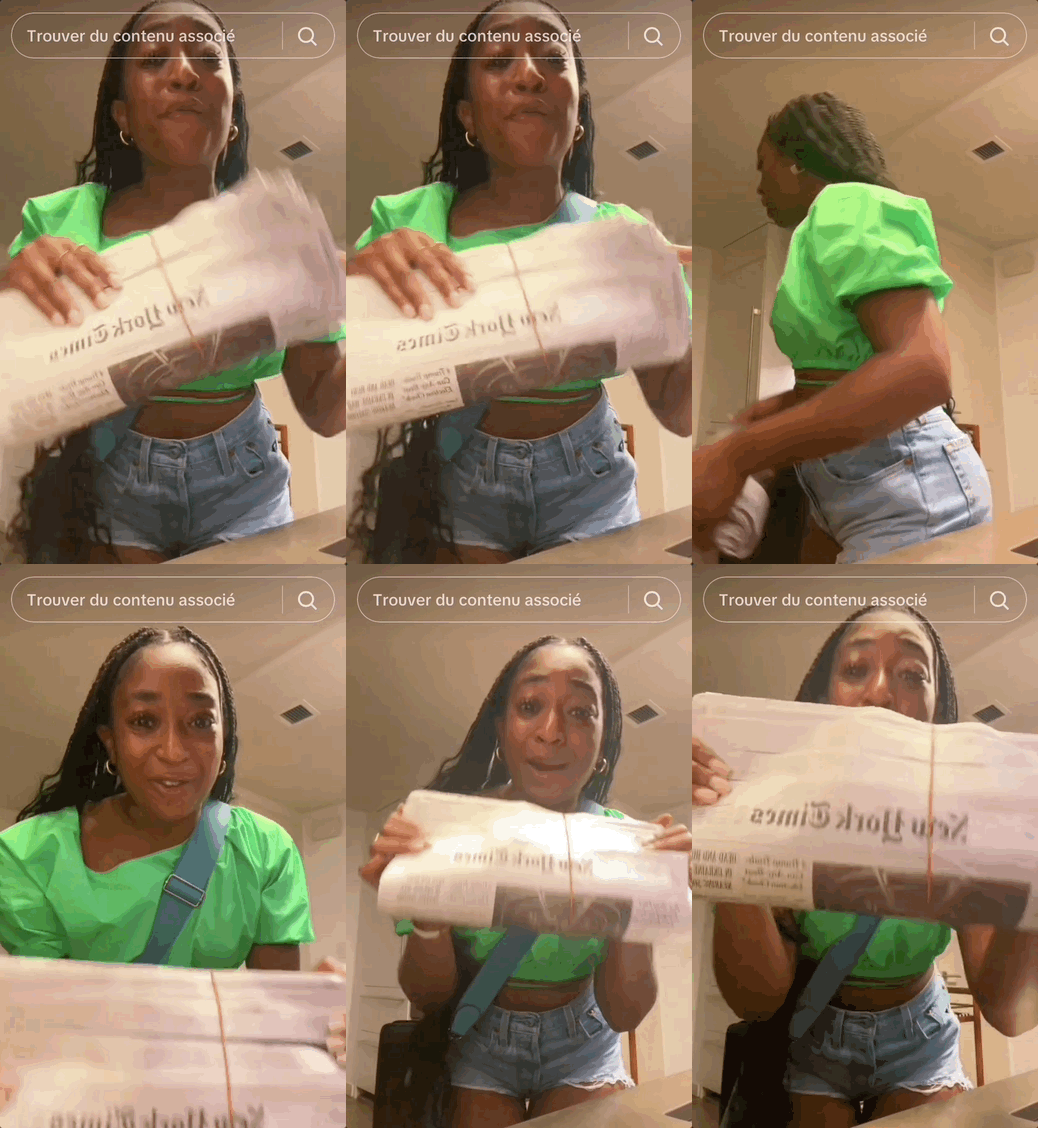
The student quickly took the initiative to turn to TikTok, where she already had a small community of around 40,000 followers. « I was also dealing with quite a bit of anxiety related to my personal life at that time » she adds. « The journal gave me a sense of relief that I had never experienced before. I felt better emotionally and I wanted to tell my community how I had managed to achieve that ». Thanks to the journal, she can now take time to read about topics that can sometimes be anxiety-inducing, she explains, without being bombarded with additional information or advertisements.
Her videos accumulate tens, even hundreds of thousands of views. An unexpected success in her view: "I knew our generation wanted to consume information in a healthier way. What I didn't know was that my video would fill that gap for so many people and give them the chance to learn".
Media influencer
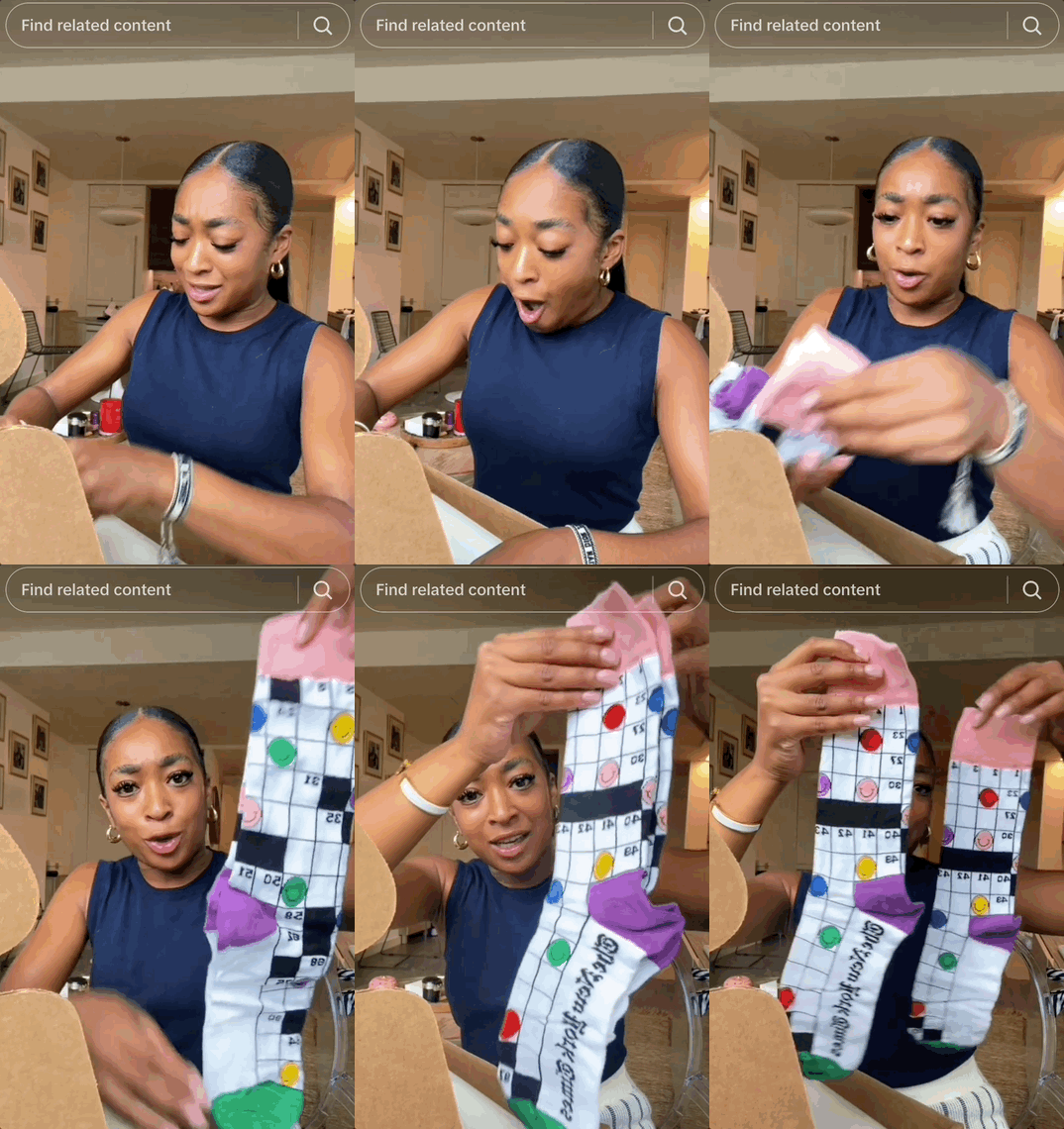
A success that doesn't go unnoticed, particularly by the New York Times. A week after posting her first video, Kelsey Russell receives a package from the American newspaper. "So cute!" she exclaims, unwrapping crossword-patterned socks branded "New York Times Games" and a water bottle featuring the logo of the hit game "Wordle". Shortly after, an employee of the newspaper even invites her to visit their offices, located in New York. A visit that became the subject of a dedicated video, posted on her TikTok account and viewed nearly 25,000 times.
But New York Times isn't the only media outlet to have identified the potential of Kelsey Russell's work on TikTok. "I'm overwhelmed," she says with a laugh, listing the media outlets that have contacted her, "Wall Street Journal, USA Today, Washington Post as well as other independent media outlets." To date, these media outlets have simply offered her free subscriptions or sent her branded merchandise in hopes of being mentioned in one of her videos. For now, none of her videos have been part of a paid partnership. This new status as an influencer is something Kelsey claims proudly, even signing her emails with the title "Media Literacy Influencer." However, she insists, her role is not to save the press, nor to promote one media outlet over another. "I want people to know that I'm here to help them. Not to help the New York Times, not to help the Washington Post. It's purely a movement for media literacy."
Nevertheless, the role of influencer could become increasingly important in media marketing strategy, as some studies suggest that younger people are gradually turning to celebrities and influencers rather than journalists or mainstream media when seeking information online. According to Kelsey Russell, media outlets also need to improve their offerings if they want to win back the hearts of younger audiences. "Gen Z is facing major challenges and the fact that the print press isn't interested in that is pretty ridiculous. I think they tell themselves it wouldn't sell". In her view, media outlets are also lagging behind on accessibility issues, particularly in how certain topics are covered and in the recruitment of journalists.
Create a space for exchange
Not everything is rosy in the world of press and information, and Kelsey Russell doesn't try to hide it. While reading an article about accusations of electoral fraud in Zimbabwe, she encourages her community to question how these issues are covered in mainstream media: "I pray for the day when media will acknowledge the role of imperialism and colonialism in stories like this in Africa". She also takes time to examine media outlets like the New York Post, and doesn't hesitate to criticize certain aspects of it, believing it's important to distinguish between "tabloid" and "newspaper".
Kelsey also uses her exchanges with her audience to discuss other issues such as the pollution caused by paper newspaper production, as well as subscription costs. "Don't forget, you're not just paying for the news," she reminds viewers in one of her videos, "you're paying for the integrity, security and expertise of the journalists you want to read".
While she encourages young people to turn to paper as an information medium, her message is not a plea against social networks, and certainly not TikTok. "There's no reason to fight against what people love. And people love TikTok, me included." she points out. She even sees it as a space conducive to spreading new ideas. "I see TikTok as a first step," she assures, notably mentioning the possibility of launching a podcast in the future, or even creating her own press company. "I don't have the ambition to save the world," she concludes, "I just want to have a positive impact on at least one person. I feel like I've achieved that, now I just can't wait to keep going!"


