


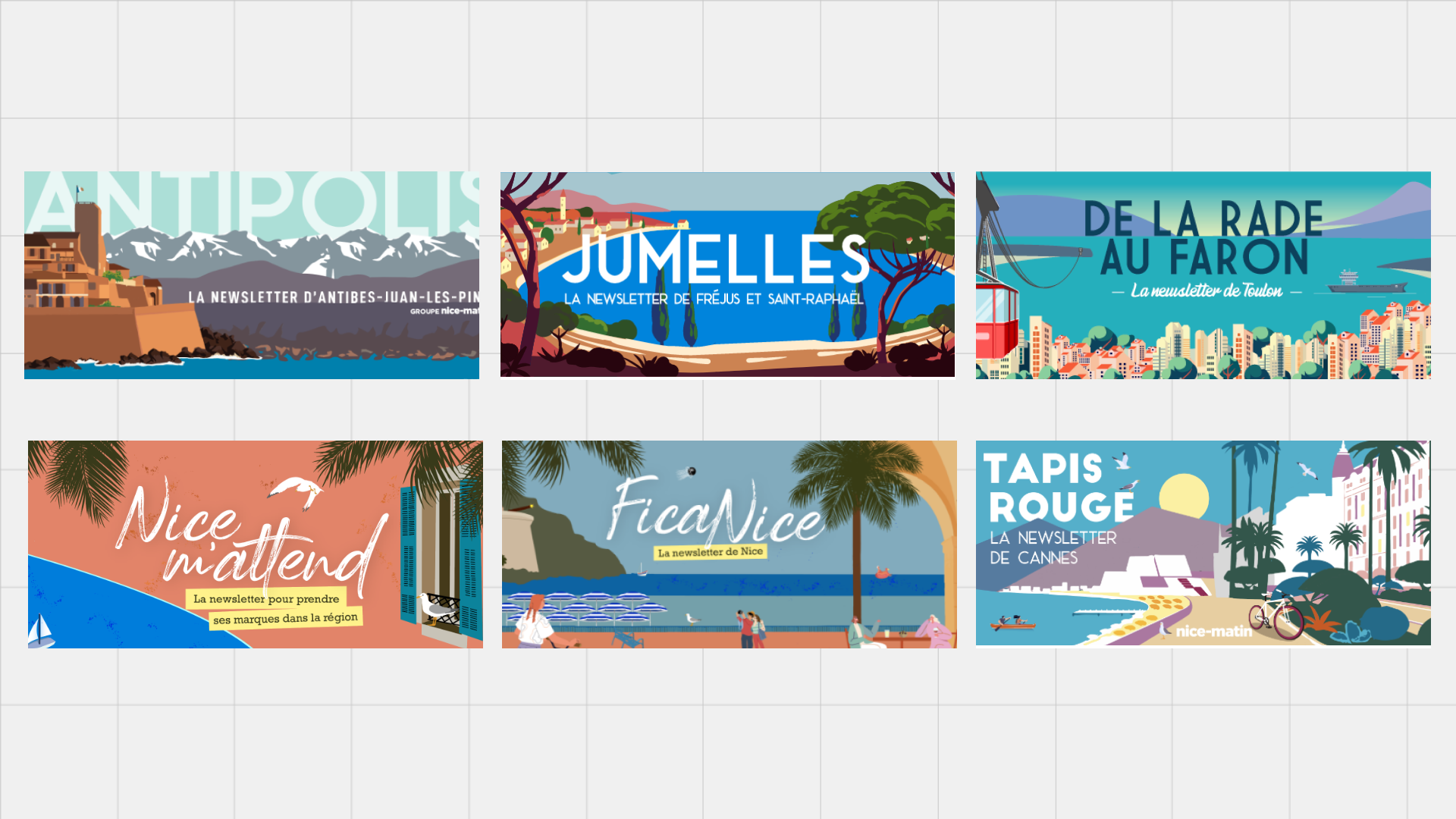
Since paper costs soared, daily and regional newspapers have tended to consolidate their editions. This led Nice-Matin to launch newsletters focused on individual cities or small population areas. In March 2022, the group rolled out its first hyperlocal newsletter. Named Jumelles, it covers the towns of Fréjus and Saint-Raphaël, two adjacent municipalities with a population of 85,000. This was followed by Tapis Rouge, covering Cannes, then Antipolis, for Antibes and Juan les Pins. The group is now preparing to launch two new hyperlocal newsletters dedicated to Nice and Toulon, as well as a newsletter for newcomers to Nice. This will feature eight episodes and provide newly arrived residents with insights into the city's history, heritage, cuisine, as well as practical advice on settling in and handling administrative procedures.
Olivier Marino is deputy director of editorial operations and responsible for the editorial strategy of the regional press group Nice-Matin. He explains the strategy behind the launch of these different hyperlocal newsletters. The heart of the project? Bringing service-driven news to life.
Today, Nice-Matin has three free hyperlocal newsletters. Can you give us an overview of their current success in terms of subscribers and engagement?
The first one, Jumelles, now has 8,300 subscribers, with an open rate of around 38% and a click-through rate of 1.71%. For Tapis Rouge, the Cannes one, we have 6,040 subscribers, an open rate of 44%, and a click-through rate of 2.16%. And for Antipolis, the latest one, we're at over 3,700 subscribers, an average open rate of 60%, and a click-through rate of 15.75%. If the figures for this last one are higher, it's surely because it benefited from the experience of our first newsletters. Sections were added, we provide unusual tidbits of information, and we incorporate more anecdotes about the city's history.
Beyond these metrics, how do you measure the success of a hyperlocal newsletter?
We see this especially in the growth of the number of registered users. Since the launch of Antipolis, we've achieved growth of over 60% in additional registered users. For Jumelles, it's 70%. This is a new audience because they're not former subscribers. Our objective is acquisition. We know we're reaching new readers, people who were quite distant from the brand and didn't consult us much. What works is the editorial offering focused on leisure and outings. There was strong demand for a product like this.
How much does the choice of send time tip the balance?
At first, we sent our hyperlocal newsletters on Fridays. Then we received feedback from readers who explained that it was a bit late to plan their weekend. We want to be very responsive to our editorial offerings. Apart from a brief summary at the beginning of the newsletter capped at three items maximum, we don't do breaking news. We focus much more on the agenda for the upcoming weekend and week and on local tips and recommendations. Following feedback from our subscribers, we decided to send our hyperlocal newsletters on Thursdays. Since then, our results have been much more significant.

What were the stages of your customer acquisition campaign?
We ran a sponsored Facebook campaign, very carefully targeted geographically to the affected municipalities and their neighbouring areas. We also posted organic content, still on Facebook, published an article in the local news sections and one on the website. Next, we sent an email to former subscribers and notified our current subscribers via the Subscribers' Club newsletter. We also continue to include a signup form on all articles tagged with the relevant municipality to recruit people reading articles from that area. It's essential to properly fine-tune your acquisition campaign. Before we even launched the Antipolis newsletter, we already had 1,500 people pre-registered. We never add people who are already in our contacts—that's not useful to us. We make sure to have the most qualified audience possible, people who are genuinely interested. Our goal isn't to sign people up just for the sake of it.
Do people who sign up for your newsletters subsequently subscribe to a plan?
That's the ambition! For now, we're avoiding pushing subscriptions at all costs. We want to build a relationship of trust before proposing a marketing offer. Recently, we launched an email to our subscribers with a discovery subscription offer, free for a given period. But we don't yet have the necessary tools to know whether the people who subscribed came from this channel.
How do you organize internally to launch these newsletters?
For Jumelles, our first hyperlocal newsletter, we organized meetings with journalists from the local agency in Saint-Raphaël, responsible for covering the sector. The project immediately excited them. Together, we decided on the newsletter's editorial offering, then we reached out to the marketing team to organize the newsletter's launch and promotion. We then produced a few test issues to trial the project, followed by the official launch. Today, we have a kind of cross-functional project team working across marketing, creative, and editorial. Local journalists are involved in developing and creating the concept.
Do you use specific tools for sending?
We use Marketing Cloud, Salesforce's solution, but it's not necessarily the best fit. We found that our newsletters didn't render well and had compatibility issues on certain browsers and email clients. It's also not ideal for our journalists. Previously, our journalists would prepare their newsletter in an Excel file that we'd send to the marketing team. They would then edit it in Marketing Cloud and handle the sending. Now we use Sendinblue, which became Brevo. Journalists edit their newsletter there, and then we generate the code that's imported into Marketing Cloud for sending. It's cleaner and better suited to our needs, and it gives us better rendering.
What will your next newsletters look like?
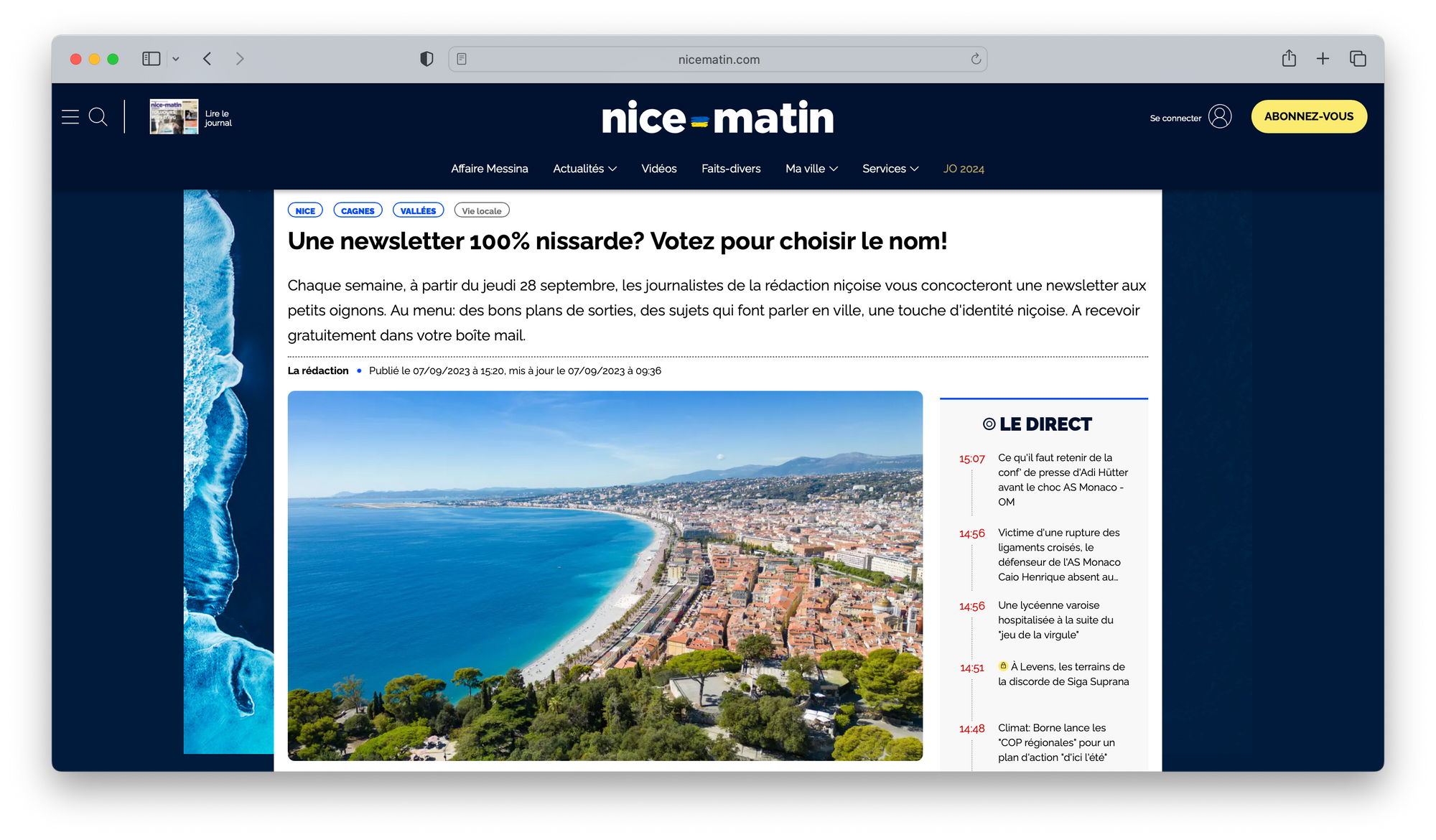
We are launching Ficanice, a newsletter dedicated to Nice on September 28, and De la rade au faron, our newsletter about Toulon on October 5. To generate engagement, we had readers vote on the names of these newsletters. We submitted three proposals to them via the website and collected 500 votes. We also plan to launch a new concept with Nice m'attend, a limited-run newsletter for newcomers to the region. With the Covid effect, many Parisians moved away and naturally, Nice attracted people. On our end, quite a few new colleagues from Paris newsrooms or elsewhere also joined us. We came up with the idea of creating a newsletter with eight or ten episodes with a scenario that subscribers would receive every week. The first episode will focus on the city, its heritage, its history. Others will be more practical and could cover real estate: how do you find an apartment in Nice? What are the neighborhoods? We could imagine adding an interview with a real estate expert. We would also include a guide to administrative procedures to follow when you arrive in Nice, practical information about the town hall, and an entire episode about our favorite places and where to eat. In any case, there will be no news or hard news.
The idea is to provide a service to readers?
Exactly. As a local media outlet, that's part of our mission and our DNA. We also want something more editorial, where the editorial team can put forward a personalized message by showcasing our offering, our platforms, or by proposing a discovery offer. The bet is that if we've engaged a reader over roughly two months and provided them with relevant services, it will be easier to convert them into a subscriber.
How do you plan to drive this incarnation forward?
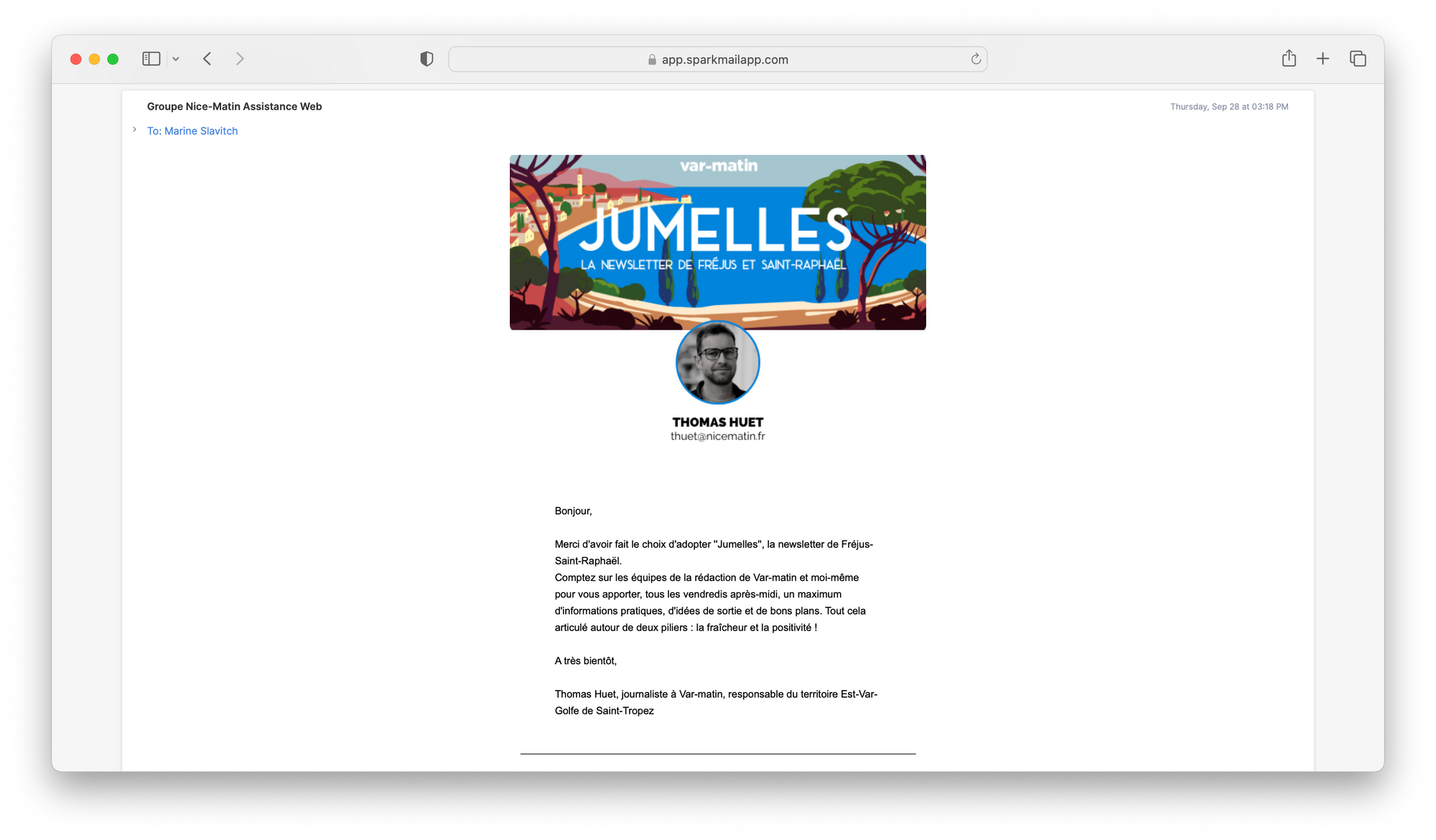
Our priority today is to build relationships. Every person who signed up for the newsletter receives a personalized message from one of our local newsroom journalists with a photo and a first-person message thanking them and telling them what they'll find in the newsletter. In our hyperlocal newsletters, we always include a short first-person paragraph. Our tone is like writing an email to a friend telling them what you're planning to do this weekend. The newsletter is the digital format that comes closest to print. We use it to recapture the closeness we've somewhat lost with our readers. Hence the hyperlocal idea—to focus on a specific community, on something with a strong local identity. Then, in how we present it, we say: "here we are, your on-the-ground journalists, and even though we're part of a large group, even though there are many of us, you have a face you can identify with". We're inspired a lot by what Norwegian media do with onboarding. When you subscribe, you can follow a journalist and they become your guide.
Between print, web, and hyperlocal newsletters, how do these platforms communicate with each other?
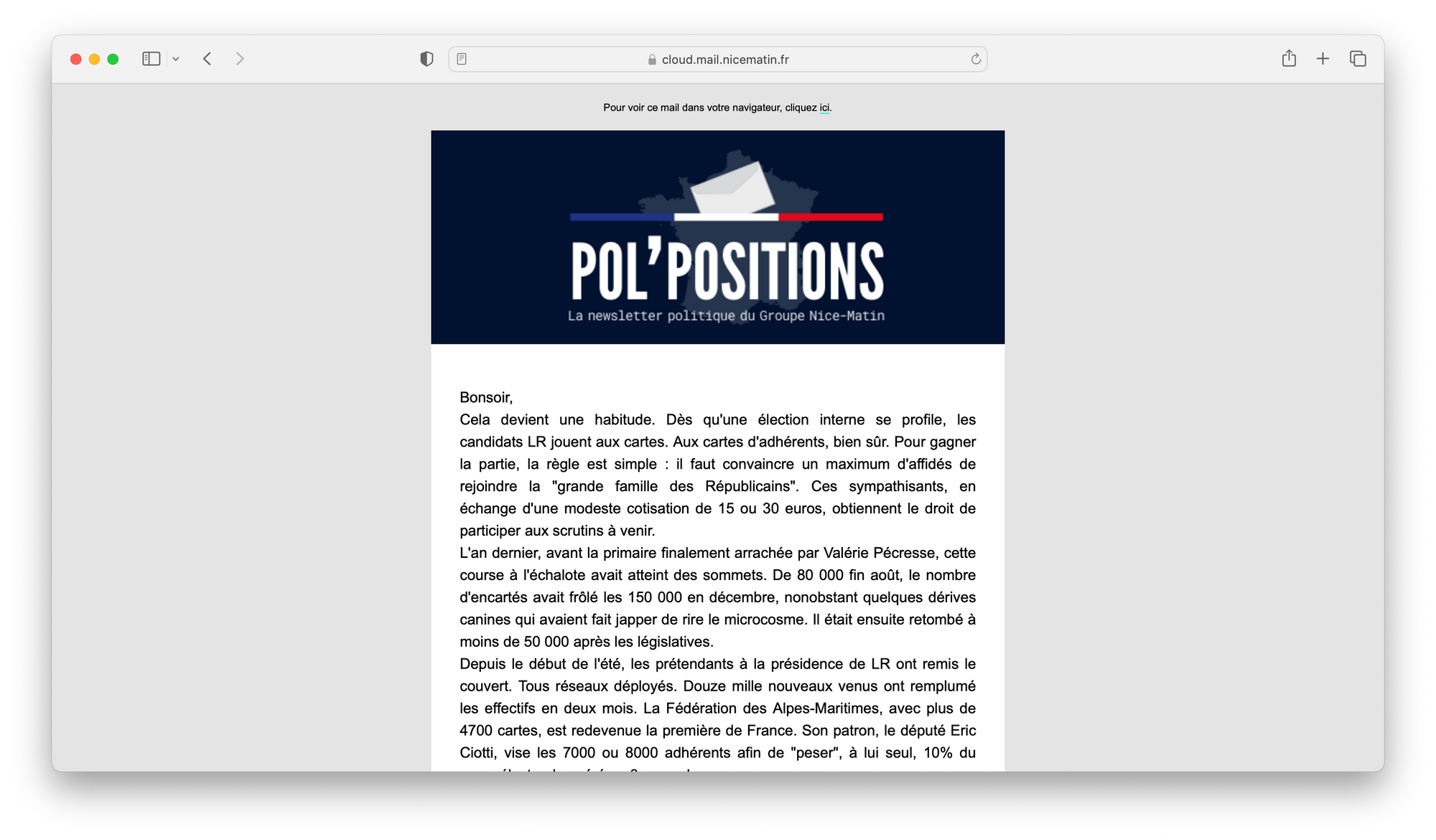
We're working to create more and more bridges between these platforms. We have a political newsletter, Pol'Positions, which we launched at the time of the 2022 presidential election. It's become very substantial, with high-quality information. It was free initially but the editorial quality has become so strong that we decided to make it exclusive to Nice-Matin subscribers. At the end of the month, this newsletter will be sent Friday evening to subscribers and integrated into the Sunday newspaper. These aren't necessarily the same audiences. Not everyone consumes information in the same way. I think we could also integrate the ideas we find in our hyperlocal newsletters into the Friday or Saturday newspaper. It's a good way to give content a longer life and allow it to reach other audiences. When you have interesting editorial material, it's a shame to limit it to just one platform.
Do you use feedback from your readers to evolve your editorial offering?
It all started with that feedback. A few months after launching Jumelles, we sent a short survey to our readers. In the responses we received, people asked us for practical information and lifestyle content rather than news. How to make the most of your weekend, how to discover the area… We adapted. At first, we included five news items at the start of the newsletter. We cut that back significantly. Since the news recap comes first, we can't make it too long or people have to scroll too much. We also reduced the number of visuals to get to the practical information faster. The tricky part was convincing the journalists to go along with it, because they're always drawn to news and current events. Now everyone's on board, and it's working pretty well.
What key lesson have you learned from launching these hyper-local newsletters so far?
Service information. I've realized we're really expected to deliver on this. The busy city dweller is swamped all week. They don't often have time to check the news. They get notifications but with kids and work, it's complicated. And when the weekend arrives, they wonder what they could do. There's this frustration that can build after reading the paper and thinking "you know, there was that event, I could have gone, too bad". We try to get ahead of it. Building a relationship with our readers, I think that can improve how they feel about their local media. Most importantly, what's really powerful is creating habits. Our newsletters are very structured, our readers always know what to expect when they open them.
To go further
- How to editorialize your local newsletter? A few practical cases with Nice-Matin, Actu.fr and Marsactu.
- Objectives, format, distribution… Our practical guide to create, launch or optimize your newsletter.
- Tech and design challenges: the 5 things you need to know to design your newsletter.
- It's the bible for newsletters: 52 tips, tools and best practices to grow your audience.
- Have you thought about referrals? A great way to retain customers and reach a new audience.
- Operating in limited geographic areas, some media outlets practice what is known as "hyperlocal" journalism, staying as close to the ground as possible. Some choose to pool their efforts, for practical, economic, or journalistic reasons.
- A good example of diversification: turning a newsletter into a physical object. Read our interview with Jean Abbiateci, author of the Dictionary of Extraordinary Words, a book that compiles the best from his newsletter Bulletin.


