


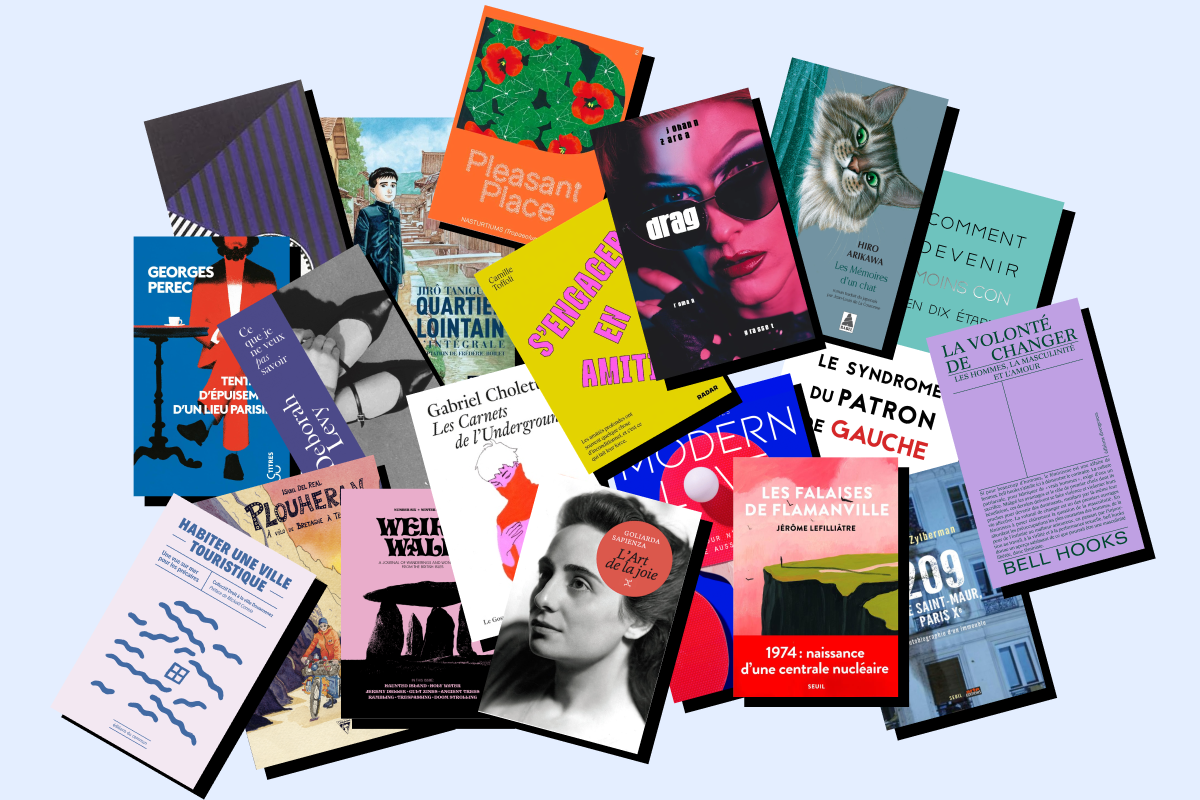
Marine Doux's Choice — Questioning Masculinity
The Will to Change: Men, Masculinity, and Love— bell hooks, Éditions Divergences
A feminist work that questions masculinity and opens perspectives on what a liberated, and thus feminist, masculinity could be.
Editors' summary: For many men, feminism is seen as a women's issue, but bell hooks sets out to prove otherwise. Patriarchal culture demands sacrifice from men to manufacture "real men". Despite the advantages and privileged role they enjoy, they must do violence to themselves and to those close to them in order to become dominators, thereby mutilating their emotional lives. The will to change is one of the first feminist works to clearly pose the question of masculinity. By addressing men's most common concerns—from fear of intimacy to romantic unhappiness, workplace pressure, virility, and sexual performance—bell hooks offers a striking glimpse of what a liberated, and therefore feminist, masculinity could look like.
Marine Slavitch's choice — taking an interest in places
209 Rue Saint-Maur, Paris 10th, Autobiography of a Building — Ruth Zylberman, co-published by Seuil/Arte Editions
It's a building like so many others in Paris. From the outside, it's nothing special. From the inside, it's a different story.
Publisher's summary: Tracing the past and present lives of residents in a building in Paris's 10th arrondissement, Ruth Zylberman delivers a magnificent narrative. Since the 1850s to today, generations of children, craftspeople and workers, immigrants from Eastern or Southern Europe have succeeded one another within its walls. Love stories, friendships, and tragedies have unfolded there. There, the ordinary rhythms of daily life have brushed against the extraordinary of news stories and the violence of History. Ruth Zylberman offers a moving reflection on traces of the past, the places where memory dwells, and the invisible bond between the living and the dead. For this autobiography of a building is also a form of self-writing.
An Attempt at Exhausting a Place in Paris — Georges Perec, Christian Bourgois Éditeur
There's beauty in the mundane.
Editor's summary: In October 1974 Georges Perec stationed himself for three consecutive days on Place Saint-Sulpice in Paris. At various times of day, he noted what he saw : the ordinary events of the street, people, vehicles, animals, clouds and the passage of time. Lists. The insignificant facts of everyday life. Nothing, or almost nothing. But a gaze, a human perception, unique, vibrant, impressionistic, variable, like that of Monet before Rouen Cathedral. The thousands of small unnoticed details that make up the life of a great city – of a neighbourhood in a great city. The countless imperceptible variations of time, light, scenery, of the living. Buses, dogs, passersby, tourists.
Suburbs. Around the Aubervilliers Fort — Raphaël Meltz, Le Tigre Éditions
A little book for urbex enthusiasts.
Publisher's summary: An evocation of Fort d'Aubervilliers and its surroundings, two kilometers from Paris. The author recounts his wanderings and the transformations of the former fortification.
Owen Huchon's choice — enriching his zine collection
Weird Walk
A collection of zines about British folklore, its myths and remnants that continue to inspire today's artists, captivated and driven by the mystery they emanate.
Pleasant Place!
Three issues on the art of gardening, the latest of which came out last June and focuses on composting. In 40 pages, Pleasant Place proposes to study the garden from new angles and explores numerous themes, whether the image of the enclosed garden in art or compost in video games.
Caroline Fauvel's choice — celebrate, explore, love
The Underground Notebooks — Gabriel Cholette, Le Gospel
A narrative to lose yourself in between Berlin and Montreal to the rhythm of nights out, encounters and memories. A singular narration, raw words to underline the frenetic reality of youth searching for itself. We follow the author through the maze of techno nights, cramped apartments and dark rooms, interweaving incandescent life stories, the sensation of devouring a diary of pure realism.
Editor's note: A PhD candidate in medieval studies by day and club kid by night, Gabriel Cholette documents his nocturnal wanderings with unflinching honesty, set against a backdrop of techno, drugs, existential questions, romantic and sexual encounters, and explorations of spiritual and physical limits. A heir to the narratives of Guillaume Dustan, Dennis Cooper, and Bret Easton Ellis, he captures as no one else the hangovers, romantic dead ends, exhausted bodies, failed relationships, and anxieties of contemporary youth. From Berlin to Montreal, from Paris to New York, Gabriel Cholette examines our times through the lens of his own intimacy, laying himself bare to deconstruct the contours of our relationships and the boundaries of our collective behavior.
Living in a Tourist City, A Sea View for the Precarious — Mickaël Correia, Éditions du commun
An essay that questions one's perceptions of lived territory, between everyday challenges and transitional space. The book focuses mainly on the case of the city of Douarnenez in Brittany and highlights the class struggle that unfolds within so-called tourist cities. A thoughtful approach to viewing our vacation destinations from a different perspective.
Publisher's summary: What kind of city do we want to live in? This is the question that begins the work of the Droit à la ville Douarnenez collective. The Breton city has experienced a real estate boom in recent years. Prices and the number of second homes are increasing, and residents are finding it increasingly difficult to find housing. The city is transforming, but for whom?
Committing to Friendship — Camille Toffoli, Éditions Écosociété
I remember choosing this book from the shelves of L'Affranchie, drawn as much by the relevance of the subject as by the quality of the object itself. It's a handbook on education in multifaceted friendships, interweaving testimonies and analyses, lending greater depth to this unconditional term that constantly occupies our world. A fine way of putting words to something one couldn't really theorize.
Editors' summary: Friendships change how we relate to the world. Whether fleeting or lifelong, on the sports field or online, all the friendship stories shared here bear witness to the power of friendship and its liberating potential. A book to give friendship a central place in our society and in our lives.
Mathilde Carlier's Choice — A Memory
Living Autobiography — Deborah Levy, Éditions du Sous-sol
In her "Living Autobiography" project, Deborah Levy revisits the defining episodes of her life, starting notably with her childhood in South Africa in the 1960s with The Cost of Living (2013). She recalls her childhood memories, her father, apartheid, her arrival in England… She also traces her path to writing, citing literary references (Duras, Woolf, Orwell, etc.) that allowed her to find (and raise) her voice.
To continue reading: Cost of living and State of affairs.
Christelle Perrin's Choice — Steering Her Own Course
Plouheran — Isabel del Real, self-published
A solo cycling journey to encounter stones and people, taking us beyond the gates of Europe, through deserts, mountains, plains, and existential doubts. A graphic novel in which words and illustrations rival each other in sensitivity.
The Editors’ Summary: One fine morning, I decided I was going to leave home and ride my bike to Tehran. Of course, I told everyone about it. “But you’ve never ridden more than 40 km on a bike—you’re not athletic,” and then, “Come on, a girl all by herself!”—the sensible people would tell me. During the day, I’d just laugh in their faces. At night, I’d wake up in a panic, covered in cold sweat and with a knot in my stomach. How was I going to face the nights alone in the forest? Yet there comes a moment when the fear of staying behind outweighs the fear of leaving.
The Art of Joy — Goliarda Sapienza, Le Tripode
This is the delightfully rhythmic and beautifully written story of a Sicilian woman from the early 20th century who, decade after decade, has only one goal: to chart her own course to live her best life, no matter what.
The Editors’ Summary: It begins with silences or screams. Young Modesta spends her nine years in the blazing Sicilian lethargy, caught between a half-mute mother and a disabled sister. It will take blood and fire to wash away all this filth. Taken in by a convent, the child she is no longer will learn words, pleasure, and the thirst for power. Born at the dawn of the century, in 1900, she outpaces it: she will become a woman—and a powerful woman—through sheer determination. Even if it meant enduring an arranged marriage and defying the curse of her bloodline. A libertarian and a libertine, an aristocrat and a socialist, ambitious, a poet, a member of the Resistance, a mother, a grandmother, and a lover—sometimes contradictory, yet always hungry for happiness—Modesta thus traverses half a century of Italian history. Driven by an indomitable inner fire. That fire she drew from the Sicilian sky, that joyful blaze she reveled in throughout her life, like a body basking in the sun…
Baptiste Thevelein's Choice — To Challenge
The Cliffs of Flamanville — Jérôme Lefilliâtre, Seuil
The Editors’ Summary: Flamanville, 1974. This village at the tip of the Cotentin Peninsula is torn apart by the announcement of the possible construction of a nuclear power plant. Will the plant breathe new life into this small town on the Manche coast by ushering it into the modern era of energy? Or, with the destruction of the cliffs and the nuclear risk, does it spell an ecological disaster? The mayor, André Rouxel—a former mine diver who is conscientious, pragmatic, and perhaps too soft-hearted—decides to organize a public consultation in an effort to calm tensions. But the exact opposite happens: he finds himself facing unexpected alliances. On one side is the mayor’s pro-power-plant faction, including shopkeepers and factory workers; on the other, the faction led by the penniless châtelaine, Jacques and Clémence Legendre—young eco-conscious teachers—as well as fishermen and farmers. And meanwhile… Victor Kaminski, a taciturn and outcast shepherd, far from the fury sweeping through the residents of Flamanville, has made the cliffs his refuge.
The Left-Wing Boss Syndrome — Arthur Brault-Moreau, *Out of Reach*
The Editors’ Summary: Born in 1993 and a graduate of Sciences Po, Arthur Brault Moreau had a bitter experience with left-wing employers from the very start of his first job. Forced to acknowledge that this political stance in no way guaranteed compliance with labor laws, he conducted a survey of approximately 70 people, including many employees and a few employers. More of a guide to collective development than a personal one, this handbook provides practical tools for understanding and confronting these employers who don’t reveal their true colors.
Juliette Cahen's Choice — Changing the Past
A Distant Neighborhood — Jirō Taniguchi, Casterman
A manga that immerses us in the life of a man in his forties—who is, all things considered, quite ordinary—as he relives his adolescence. A deeply moving story about family secrets, the trauma of war, the loss of loved ones, and a philosophical exploration of the (in)ability to control one’s own destiny.
The Editors’ Summary: Hiroshi, a 40-year-old man who has been transported back into the body of his 14-year-old self, continues to rediscover his past. As he questions his grandmother, his parents, and his friends, he realizes everything he had missed when he was young. And little by little, as the school year progresses, he sees the fateful date approaching when his father will disappear—forever—without any explanation. Can he change his past, or is he doomed to relive it, powerless? And will he ever return to his normal life, to his wife and children?
Pauline Butel's Choice — Purring
A Cat's Memoirs — Hiro Arikawa, Actes Sud
A novel that is as tender as it is funny and moving, exploring friendship as well as separation and grief.
The Editors’ Summary: A street cat with a blunt way of speaking and a knack for human language has taken up residence in the parking lot of a Tokyo apartment building. He, who would never trade his freedom for anything in the world, is one day hit by a car and forced to accept the prospect of a long-term living arrangement with Satoru, a tenant, who nurses him back to health and gives him a name—Nana. Five years later, unforeseen circumstances force Satoru to part ways with Nana. Eager to find her a good owner, he turns to former classmates scattered across Japan. Thus begins a series of journeys and reunions that offer Nana countless opportunities to discover Satoru’s past and reveal to us many facets of Japanese society.
Modern Love — Daniel Jones, Phébus
Based on the famous New York Times columns, this novel presents stories of contemporary love that are by turns funny, offbeat, and daring, and at other times moving or tragic. These stories and life journeys gradually sketch out what might approach a definition of what love can be—or rather, a non-definition—in favor of a vision of love in the plural, in all its forms, always in flux.
The Editors’ Summary: What do the delightful anticipation of a young woman who has just sent a sext, the surprise of a woman whose husband disappears while she’s putting chicken in the oven, and the excitement of a long-lost childhood sweetheart rediscovered through social media have in common? MODERN LOVE! By turns humorous, poignant, irreverent, and romantic, these stories paint a true kaleidoscope of contemporary love. You’ll quickly become hooked on these everyday heroes and heroines as they reveal their desires and vulnerabilities… *Modern Love* is the most beautiful portrait of love in all its forms, set in the heart of an enchanted New York, somewhere between *Love Actually* and Woody Allen.
Melina Ferrante-Giovannoni's Choice — Transforming Herself
Drag — Johann Zarca, Grasset
The Editors’ Summary: Tony / Nita. Day / Night. Noisy / Paris. One is a young guy from the projects; he still lives with his parents and dreams of becoming an actor, but his auditions have been unsuccessful. The other is a beloved drag queen. She lights up the capital’s nightlife, but, like Cinderella, must, at dawn, shed her glamorous finery to disappear into the guise of Tony. Two sides of the same coin: one lives in sweatpants and speaks in slang, while the other is a diva who pays as much attention to her makeup as to her speech. We follow them in turn throughout the narrative as two distinct characters. But fate will soon force them to come together. From the gray towers of the housing project, where Tony’s tough-guy persona helps him get by, to the glittering world of drag queens where life seems like a party, Johann Zarca takes us from one world to the other until he brings them together, forcing his character to face the only choice left to him: unite or die.
How to Be Less Stupid in 10 Steps — Quentin Delval, Hors d’Atteinte
The Editors’ Summary: Can’t stand the sight of your boyfriend (father, brother, uncle, coworker, boss, friend, hookup, lover, husband) anymore? Give him this book. We promise: it’ll be the last thing you ever do for him. Far from being a treatise on masculinity or the need to not be “manly,” a guilt-inducing moral lecture, or a new theory promising to revolutionize relationships between women and men, this book addresses concrete, everyday situations we all face and offers ambitious yet realistic solutions.
Editor’s Note: Médianes, the design studio, has been supporting the publishing house Hors d’atteinte with its strategic development since 2022, and has been assisting Isabel Del Real with design and technical matters since 2023.


