


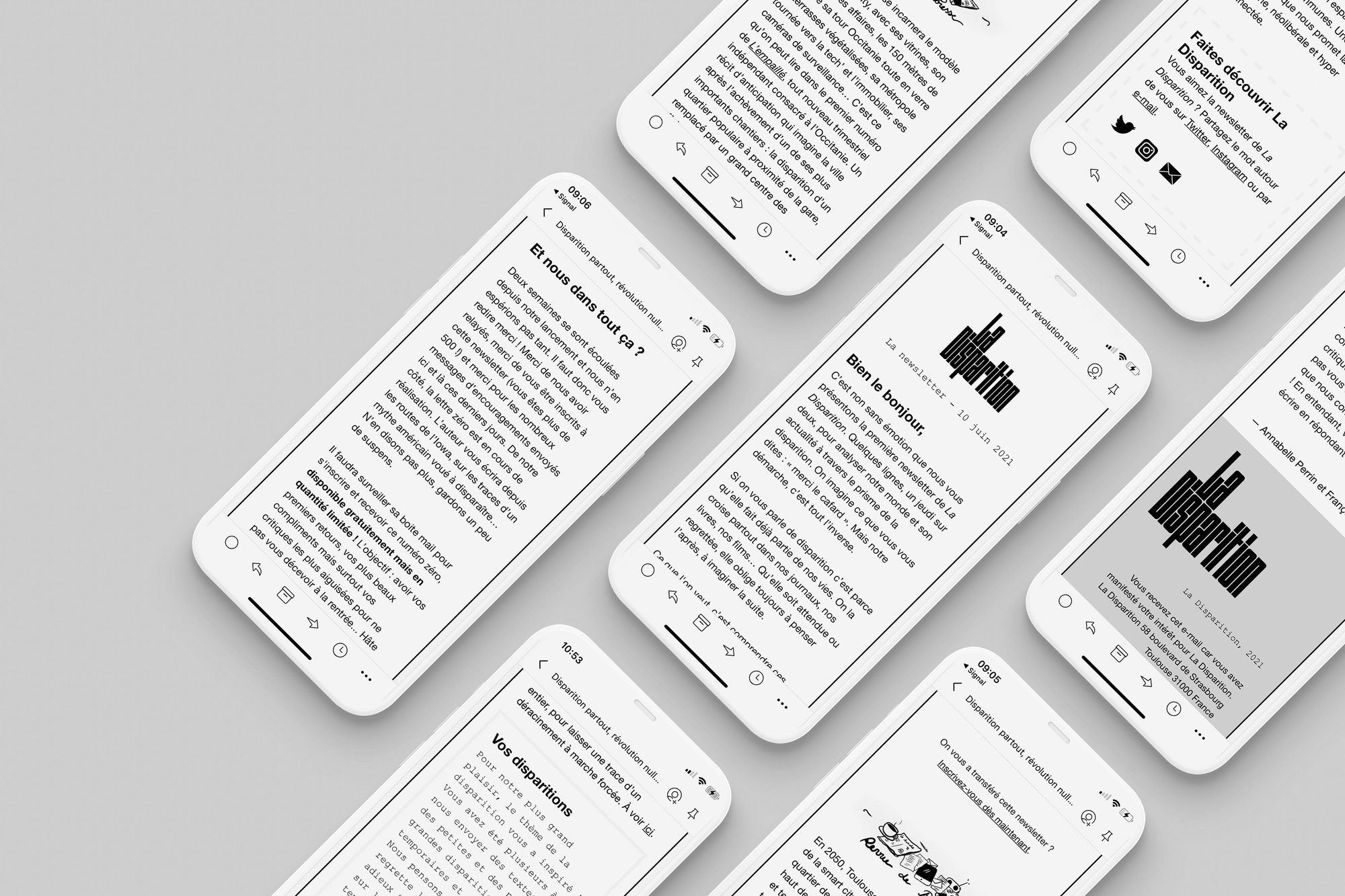
You produce letters in paper format. Why launch a newsletter alongside it?
Initially, we hadn't thought about a newsletter and we had absolutely no desire to launch one because what really interested us was this idea of the letter and print media that we're bringing with the La Disparition project. We were also worried about confusing our readers between our print letters and a potential digital newsletter. We thought people wouldn't understand what we were doing and that it risked muddying the waters. But then, we had to face facts. The newsletter could be the main way for us to exist before launching our media and our print letters. It could allow us to establish the theme of disappearances in the news cycle and prove the full relevance, originality and legitimacy of our project. Especially since launching a media project about disappearances isn't easy to defend: the theme can seem depressing, even opaque. We decided that launching a newsletter beforehand at a bimonthly pace would allow us to explain our choice to cover disappearances, which are already absolutely everywhere. It's simply a new lens for telling and analysing the news. We chose to use the six months we had ahead of us before launching our print letters to explain this vision within a newsletter. This allowed us to build an initial community and avoid ending up saying " hey, we're launching a print media, nobody knows us and we're going to talk about disappearances, subscribe! ". That would surely have been a bit strange. At first, we were gaining nearly 400 subscribers each month. We ended up with 1600 subscribers after four months.

What content did you choose for this digital letter compared to the paper version?
From the start, we knew we absolutely had to connect the theme of disappearance to current events. A press review format seemed like the obvious choice. But you have to be careful with this kind of well-trodden format—it's best to make sure you can put your own stamp on it and make something original. So instead, we decided to use this space to highlight the things we love: reading, watching films, and listening to music. Granted, anyone interested in culture always has a thousand things they're behind on watching, reading, and listening to. But we thought it could be interesting to offer cultural recommendations linked to disappearances. Especially since we're tailoring these recommendations based on themes that are making headlines.
« In mainstream media [...] cultural sections always cover completely different topics from those making the news »
On the day our newsletter covers the political situation in Chile, we'll highlight poems by a Chilean author. A story on the disappearance of winter sports will allow us to recommend a ski film. Offering cultural recommendations based on the subject—that's what we enjoyed. In mainstream media, culture appears on the back pages, clearly separated from current events, both in content and form. That's quite strange, isn't it? Cultural sections always cover subjects completely different from those making the news. In La Disparition's newsletter, we always link the two together.

You loved it so much that you even decided to launch a second newsletter. Tell us about it?
Indeed, we now send a newsletter every week! One week it's the classic newsletter and the next week what we call the logbook. This second format reveals the theme of the letter we're about to publish to entice people to order it or subscribe. We ask the author to give us a list of books, films and songs they listened to while writing their letter. We then write short pieces for all the recommendations we include in this newsletter. One person reads an essay, another listens to the album, we move fairly quickly. The difference from our first newsletter is that we cover topics that don't necessarily relate to current events and, above all, it allows us to highlight the work we also do in print. Actually, it's an enrichment of the print edition. You can read the newsletter without being subscribed to the letter and you understand the theme perfectly well, you don't even need to read the letter. But if you have read the letter, then yes, it takes on an additional dimension. If you enjoyed your reading and want to know more, you just have to search your emails for the relevant newsletter and then you see what novels, essays, music the author can recommend to you. It's complementary.
Have you succeeded in creating a community dedicated to newsletters?
We don't really use our newsletters to promote our print letters. Of course, we write in each of our newsletters "and in our print letters, you'll find this theme, this topic, here's how to subscribe if you'd like" but we put it at the end rather. We don't want to use our newsletters in an abusive way. Because there are people who don't care at all about our print letters. These people probably will never subscribe to the print version anyway but they deeply love our newsletters. When we asked them whether they preferred to receive the logbook on Tuesday or Thursday, they sent us three-page emails explaining why they preferred Thursday or why it didn't matter to them. One woman told us that she was retired, that she used to work with exiled people, and she gave us quite a great story to tell us that ultimately, Tuesday or Thursday made no difference to her. Our press review has a community that is very attached to it and that gave a warm welcome to our second newsletter, the logbook. In nearly two years of newsletters, we've gained nearly 5,000 subscribers and maintain an open rate close to 50%.
To what extent is the newsletter's tone different from that of the print edition?
Since we don't write the paper letters ourselves, the newsletter is much more reflective of who we are. It's more direct. I wouldn't say it's more committed, but it certainly allows itself more freedom. In print, we only write a brief cover note for the letter, and we make sure not to discuss politicians. We prefer to use that space to talk about substantive issues—even though politicians might arguably be a substantive issue too, anyway. The point is, in the newsletter, we allow ourselves to go a bit further, to be provocative, to sometimes be frankly irritated. In print, the discussion is perhaps a bit more philosophical.

So, was the newsletter a good idea after all?
To be honest, we didn't think the newsletter would last. At first, we told ourselves let's do this to support the launch of our print publication, it'll be good publicity for us. And then we saw our subscriber numbers grow very quickly. For three or four months, we were gaining 400 subscribers a month to the newsletter, with excellent open rates, with people writing to us regularly. We couldn't just stop everything at once. Especially since it's been a pleasure from the start. If we could hire someone to take some tasks off our hands, we still wouldn't give up writing the newsletter because we care deeply about it. Besides, I think the head of a small media outlet has something to lose by having someone else write their newsletter. Your newsletter is your direct link to your subscribers.
Doesn't this success make you want to monetize it?
Out of the question. We're not ruling out launching a fundraising campaign. We'll definitely do it when we can do it properly. But making the newsletter paid or including ads in it is a firm no. We won't put ads in our printed letters either, by the way. That would be truly counterproductive.
To go further
- Have you thought about recommendations? Whether they become Instagram posts or form the value proposition of your media, they can help you build loyalty with audiences who share your sensibility and acquire new ones through social networks.
- This interview is part of our series on independent newsletters. Find previous episodes with Léry Jicquel, founder of Concentré Vélo, Jean Abbiateci, from the newsletter media Bulletin and Léa Lejeune, founder of the feminist newsletter Plan Cash.
Editor's Note: Médianes, the studio, has been supporting the La Disparition team since its inception in 2020, in strategic development, design, marketing, and technical aspects.


