


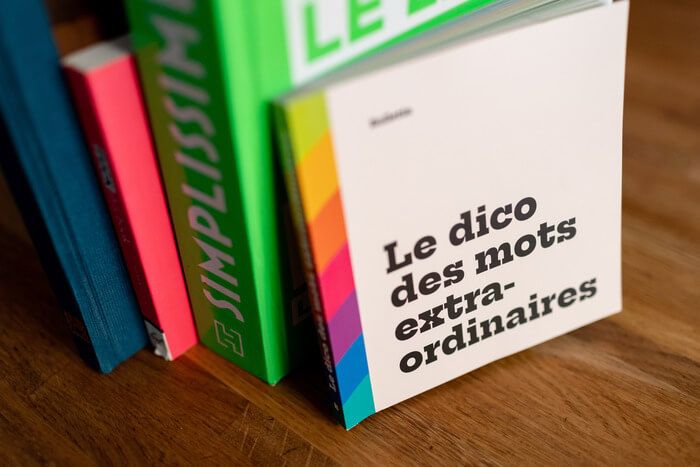
How did the idea for Dico des mots extraordinaires come to you?
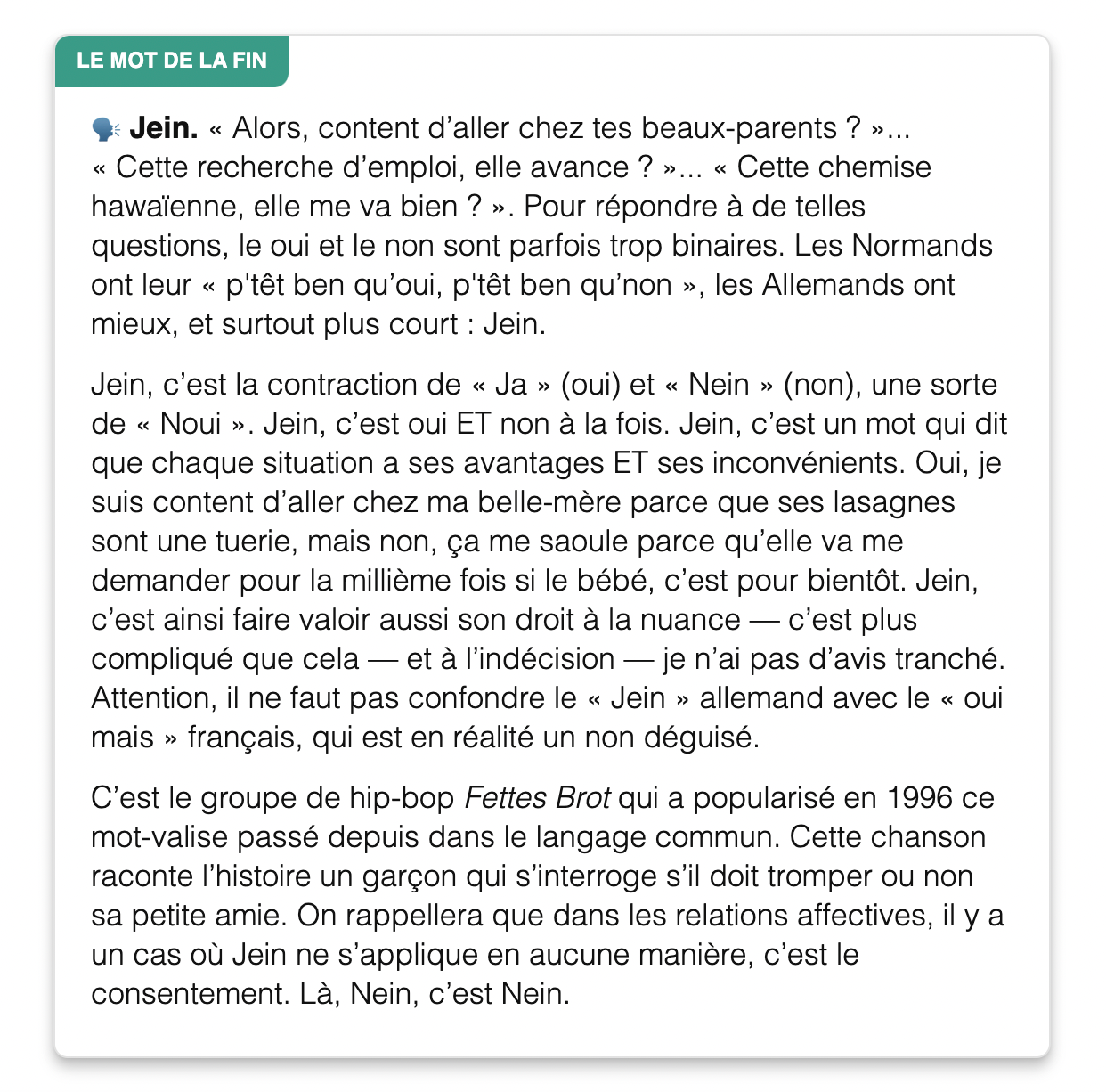
This book grew out of "The Final Word," a column that has been part of my newsletter Bulletin from the very beginning. I believe a good newsletter should always end with something nice for readers to take away. This column has also always been straightforward to write and produce. The concept is to break down each week a foreign word that has no equivalent in the French language. As the editions accumulated, I realized that people had genuinely become attached to discovering these words. Half the messages I received were related to this. And many asked me to turn it into a book. At first, I refused. I thought it would be a lot of work and I had neither the desire, nor the time, nor the means to invest in such a project. But the requests kept growing, and I eventually agreed. I knew I wasn't taking much of a risk—I was fairly certain I would at least break even, given how much demand there was.
Which distribution method did you choose?
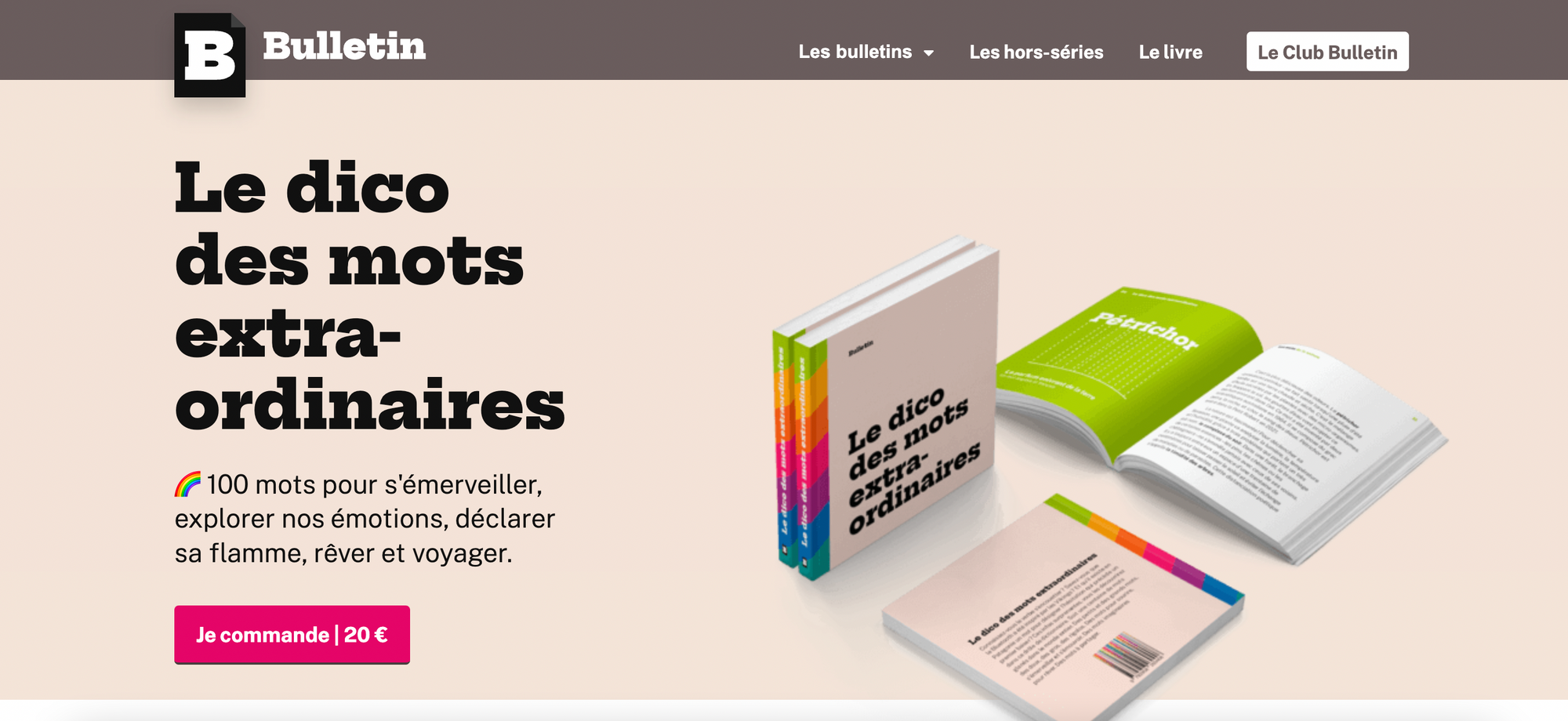
I wondered quite a bit whether I should go through a publishing house. Since the product was fairly straightforward, I quickly felt I could do everything myself. The Dictionary of Extraordinary Words is easy to produce: there's admittedly some design work, but the texts are already written and don't require much rewriting. Going through a publisher would have delayed the book's release by several months and would have added all sorts of constraints. The real question was how much the Bulletin community could be monetized through this project. After all, our subscribers have been with us for two years and we've never asked them for anything in particular. Would they be willing to buy a physical product that would bring in a bit of revenue for Bulletin? I chose to take the least risk possible by distributing exclusively online. Today, the book is present in a few Swiss bookstores because I live nearby, but we wanted to maintain maximum profit margins from an economic standpoint by avoiding distributors or middlemen.
From a design perspective, how did you manage to maintain that margin?
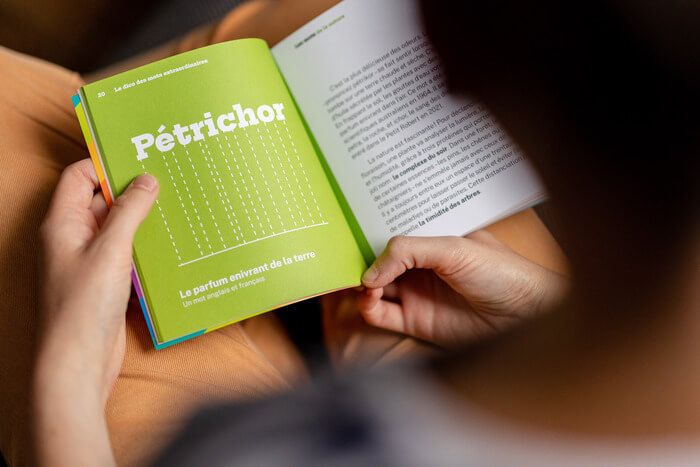
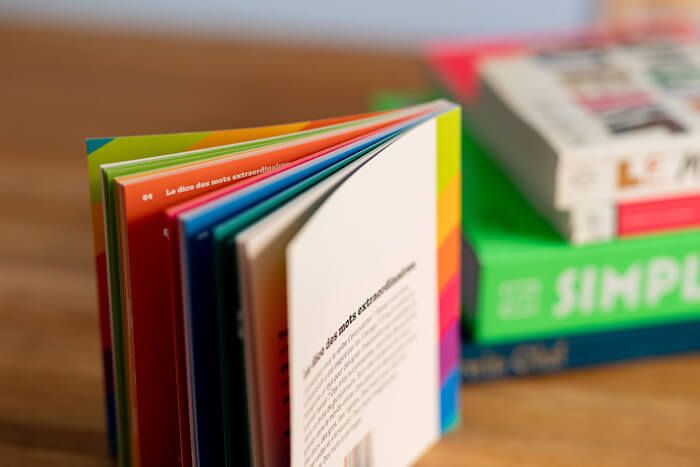
When you launch into a project like this, you have to learn to hold yourself back because you always want to create the most beautiful book in the world. We immediately wanted to make one on a budget, trying to add as few costs as possible to manufacture an object meant to bring in money, clearly. We first developed a nice layout with my designer and we asked ourselves whether or not we should integrate illustrations into it. We looked at the prices, we knew it would cost us a fortune. There are sixty words in our dictionary, which means creating sixty illustrations. So we had to rethink the product design so the book would be both nice and cheap to produce. That's why we chose to illustrate the words by playing with typography and adding a few visual effects.
« If there's an investment to make, it's in graphic design »
Why this square format?
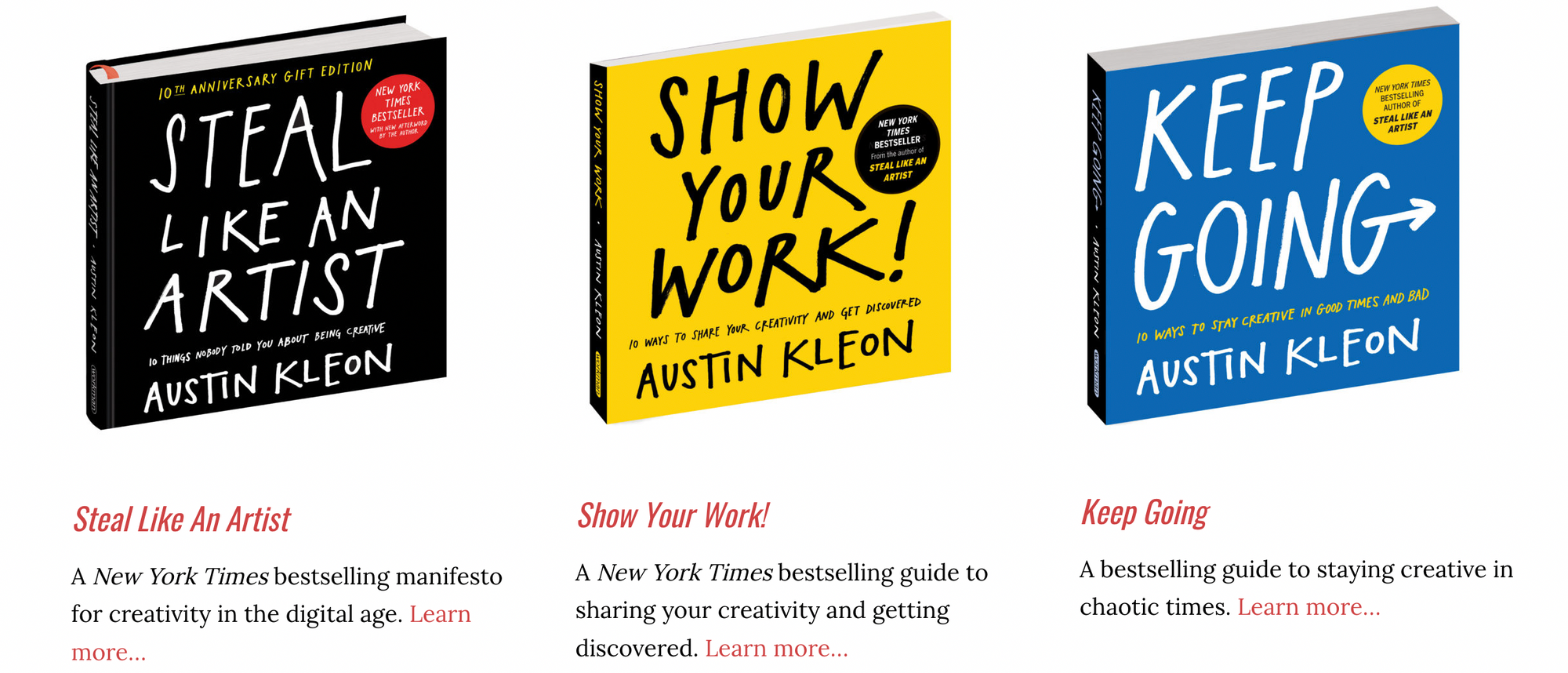
This dictionary doesn't have a massive amount of text—you can easily leave it lying around on a corner of a table. We're not talking about a linguistic encyclopedia: it's really a book for aperitifs or the bathroom, something you flip through whenever you feel like it. We tried to create a product that's both simple and highly graphic and colorful. My designer [Loris Grillet, editor's note] drew inspiration from Austin Kleon's square books about the world of work, which have a very distinctive quality that people identify with. If there's an investment to be made, it's in the design. People need to enjoy leafing through a beautiful product.
How many books have you sold?
We sold nearly 4,000 copies of the Dico. That amounts to around 60,000 euros in revenue. For a lean independent media outlet like Bulletin, this revenue stream is far from negligible. From the start, we wanted to add sustainable revenue lines that wouldn't depend on a single funding campaign. I believe you can't build a media outlet's economics solely on crowdfunding, even though it can work very well. The day those campaigns stop working, you're stuck.
Is this a sustainable product?
We chose a high-quality printer [Imprimerie des Deux-Ponts, editor's note] to avoid making a cheap book. We specifically used vegetable-based inks and recycled paper. We didn't want a book printed on some obscure site or through Vistaprint. The product is simple but it has ambition in its materials. It was also important for us to work at a local level. The Dico was designed in Evian, it's printed in Grenoble, my graphic designer lives in Switzerland. What matters to me is also having something that addresses evergreen concerns. This book will guarantee me sales over a year or two compared to a magazine that will inevitably feel dated at some point. It's much simpler to have a product that lasts over time. I wanted something durable.
How long did it take to design this book?
The working time was quite low. The design took three or four days, the rewrite four days as well. In fifteen days, most of the work was done. The most time-consuming part is the shipping. I can't quantify it. Over the year, it's manageable, but when the holiday periods arrive it quickly becomes burdensome.
Is the Dictionary of Extraordinary Words profitable today?
Absolutely. For a product like this where there's financial risk, we invested nearly 10,000 euros: a third on design and the rest on the first print run. You have to be sure you'll break even, which is why it's so important to listen carefully to your readers for a first venture like this. For a model like mine, I can't afford to spend 10,000 euros and only make 2,000 back. In this case, honestly, I was confident I'd break even. Audiences are willing to pay when you offer them something tangible, especially when it comes from a general-interest project like Bulletin. We're not La Gazette du Palais, we're not doing professional press. So people are happy to have a small print product. There's a gift-like quality to it, a sense of supporting the project too. I think it's the best idea I've had, and it's going to let me get through 2023 much more peacefully.
If you could do it over again, what would you change?
Today, my place is a mess. There are boxes everywhere. I have a house, but it's not Versailles. Books are piling up. The logistics side is quite impressive. I think if the project keeps growing, I'll try to find a mailing, distribution and packaging solution so this stage takes up less time. But it's been a worthwhile experience—you have to go through these unglamorous moments to understand and make sure that going forward, logistics match the activity. By doing it, I discovered everything! Postal rates, envelope choices, packaging, packaging materials. It's helped me develop new skills.
« For two years I asked my readers nothing but their opinion»
Do you have any advice for those who would like to unsubscribe from all or part of their newsletter?
Capitalize on what works best. The mistake is creating a product separate from your newsletter. It's better to develop a product based on the best content in your newsletter. You can conduct audience research, ask your readers directly, but generally, what works best becomes obvious quickly. We did some targeted, strategic advertising on Facebook, but the main channel by far has been loyal subscribers who've been reading us for two years. And I did very little promotion. We got some press coverage, but I didn't go chasing radio stations. That would have been especially time-consuming since I'm not based in Paris. Think about sustainability. Events work well, but when you're a small media outlet like Bulletin, it's complicated to mobilize resources. Finally, you have to keep seniority in mind. For two years I built projects that people became attached to. You can't come out of nowhere and say « go ahead, buy my book ». For two years I asked nothing of my readers except their feedback.
To go further
- What is evergreen content? The Digital Marketing Institute offers the following definition in its glossary: "This term refers to marketing content with lasting value over time. An article, video, or infographic that does not (or barely) become outdated, remaining virtually timeless or unfading after publication. This type of content remains perpetually interesting and relevant, regardless of when visitors read it. Evergreen content, also called cold content, long-term content, or sustainable content, offers a dual benefit: for search engine optimization and for web ecology."
- This interview is part of our series on independent newsletter strategies. Find the experience feedback from Léa Lejeune, cofounder of the feminist media Plan Cash, that of François de Monès, cofounder of the epistolary and political media La Disparition, and that of Léry Jicquel, founder of the Concentré Vélo, a newsletter on cycling culture news.
Editor’s Note – 02/14/23: Orders from bookstores involve a lower retail price, which explains the discrepancy between the number of books sold and Jean Abbiateci’s revenue from those sales. For 4,000 copies sold, Jean therefore earns 60,000 euros in revenue, not 80,000 euros as some readers have pointed out to us.


