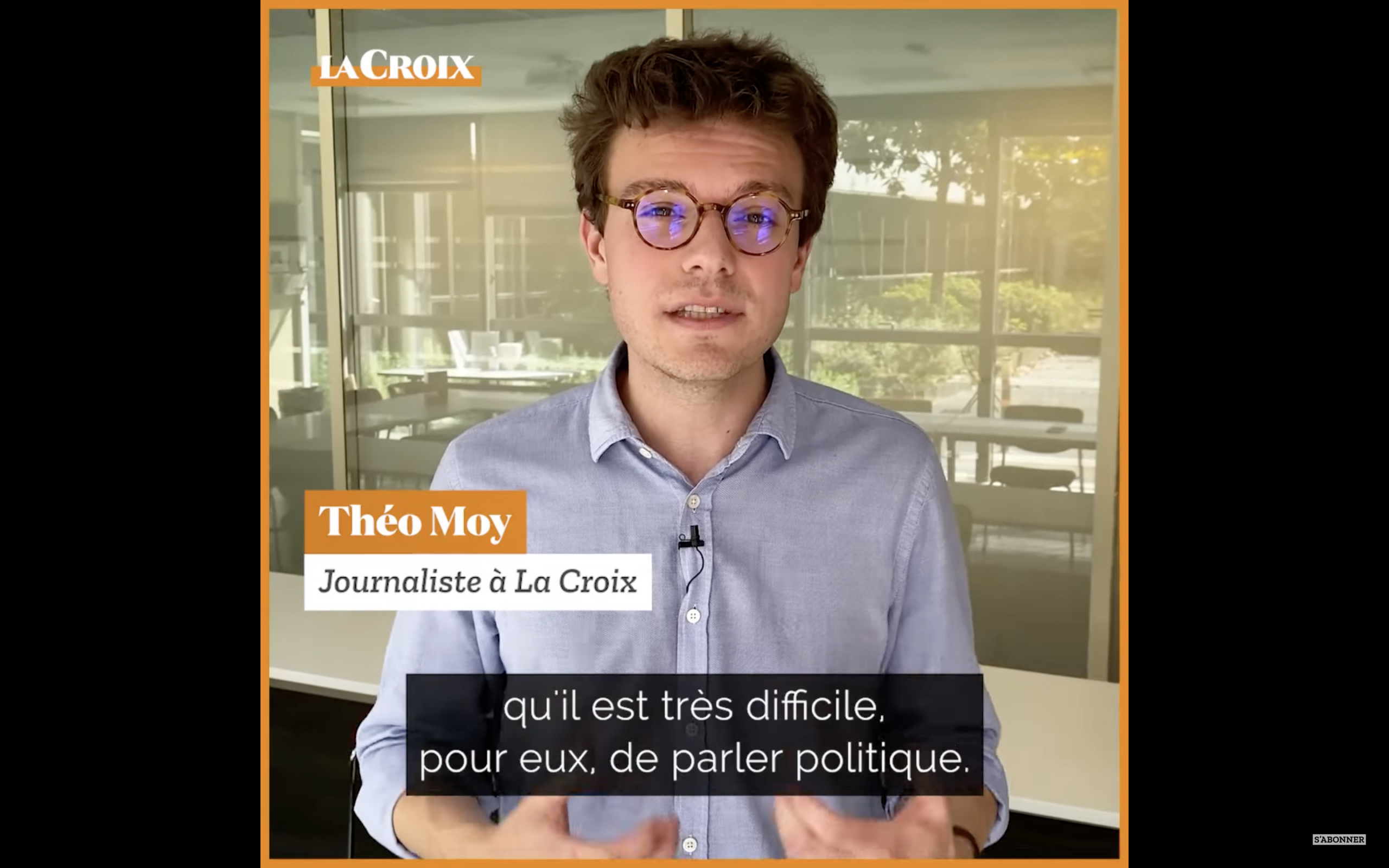
In January 2022, a new section appeared on La Croix's website: À vif, a space open to op-eds, distinct from the rest of the newspaper. Théo Moy, a journalist, is responsible for developing it. Médianes spoke with him about the construction and editorial thinking behind this section.
How did you think about the At a Glance section?
I work alongside Editor-in-Chief Isabelle de Gaulmyn. When I arrived last September, we began thinking with the editorial team about this new section. I noticed that opinion sections work very well in other newspapers, like Figarovox, the "tribunes and opinions" section of Figaro, which has become a genuine media brand. Some people read it without even reading the rest of the newspaper. As for À Vif, it is above all a genuine editorial ambition: to open up debate by publishing texts and opinion pieces on subjects concerning religion, current events, and democracy. To give voice to other actors in society than those we find in the newspaper, away from controversy and toward calm discussion. Even though the texts published in À Vif are consistent with the opinions of La Croix, the objective is to open ourselves to other points of view.
🎥 « À vif » is La Croix's forum for debate.
👉 We created it to foster the exchange of opinions and ideas, and to enable the expression of diverse perspectives on Church, society and current affairs. Introduction from our editor-in-chief, @idegaulmyn pic.twitter.com/HsdUK9iyHT
— La Croix (@LaCroix) May 13, 2022
What inspired the creation of this section?
We identified a specific finding regarding La Croix's readership: the Catholic world is undergoing restructuring, communities have drifted apart, struggle to engage with one another, and are increasingly marked by ideology. In this context, the challenge for La Croix is not to speak solely to progressive Catholics. This new section also helps open the door and give voice to other currents of opinion. Concretely, À Vif has a dedicated section on the website with roughly eight pieces of content per week, and since May, we have three pages in the newspaper every Monday.
You publish 80% opinion pieces, but also interviews. What is the editorial line of the section?
We publish opinion pieces, columns, interviews and editorials. Most concern Church-related topics but we also cover social and current affairs issues. Each time we have to select texts, we walk a tightrope between what we can publish and what doesn't align with La Croix's editorial line. For example, on bioethics issues: we won't publish an opinion piece supporting surrogacy when La Croix takes a critical stance on it. But we have for instance published an opinion piece signed by around ten Green MEPs on decarbonized inflation even though our newsroom doesn't necessarily cover that topic.
The idea is to maintain editorial consistency between the newspaper and the À Vif section. Ultimately, these are sometimes more explanatory pieces with expert value than opinion columns or even debates (Editor's Note : like this exchange between a historian and a political scientist on the question: are Catholics becoming more radical on the right?)
Beyond the editorial angle, what is its usefulness for the media?
The À Vif section, beyond offering different perspectives, serves three purposes. Strengthening our connection with readers: we receive feedback from readers, their opinions on the writers behind these pieces, and sometimes they even recommend personalities to us. Next, we have a Twitter account dedicated to À Vif, which also helps drive traffic to the website, particularly through social media. For example, stories about nuclear energy perform very well. Finally, my work on headlines is also very important because there's a major consideration around audience reach and article search engine optimization.
Specifically, what is your role as manager of this section and what should you pay attention to?
As a manager, I'm attached to the religion section but I navigate across several departments in the newsroom. My job is to sort through the texts sent to us. We have regular contributors especially on 'religion' topics, but I also invite people whose perspective strikes me as valuable to write for us. My role is to select texts, headline them, proofread them, edit them, and sometimes rewrite certain sections—and that takes time. I can also retrieve interviews conducted by journalists from other departments if they seem relevant to the section. I also do fact-checking work: who are we giving a voice to? My greatest fear would be to accept a text from someone unreliable, someone about whom there's uncertainty regarding the crucial question: from what position are they speaking? But above all, I'm attentive to our readers. The goal is to be as educational as possible.
You've established a charter dedicated to this section. Why is it important?
This helps us be very clear about our positioning and roadmap. It's as useful to me as it is to those who will submit text to us. It's also a work of transparency toward our audience. Concretely this charter has five important points: opinion pieces are signed with the author's real identity, must not contain personal attacks, discriminatory content, or attacks on privacy. They must not contain insults or incitement to violence. It's essential that they don't repeat false information or spread claims whose source is unknown.
How, concretely, do you visually distinguish the section from the rest of the media so that readers understand the difference clearly?
Until last May, opinion pieces were integrated into the "debates" section at the beginning of the newspaper. We held meetings with different departments of the newspaper to build the new section. We thought about what we wanted to do with it and what we wanted it to contribute. With the designers, we immediately opted for quotation marks to make it visible and distinguish it clearly from other parts of the newspaper. Moreover, since the section appears at the end, it is consequently easier for readers to understand its place in the overall structure of the newspaper. In the layout, the photo appears large, as does the subheading that introduces the person who signs the piece. On the website, the section's font is even different, so it stands out clearly from the others.
To go further
- How can you properly separate "opinion" sections from the rest of your media outlet? Hypernews offers very concrete examples.
- Distinguishing what amounts to opinion is a duty toward the audience, notes the Nieman Lab.
- This article is part of our Media & Opinion series published in summer 2022. Check out the introductory episode with Ben Smith, media specialist and co-founder of the newly launched Semafor and the third episode on building an editorial proposition centered on opinion with Le Drenche and AOC.