


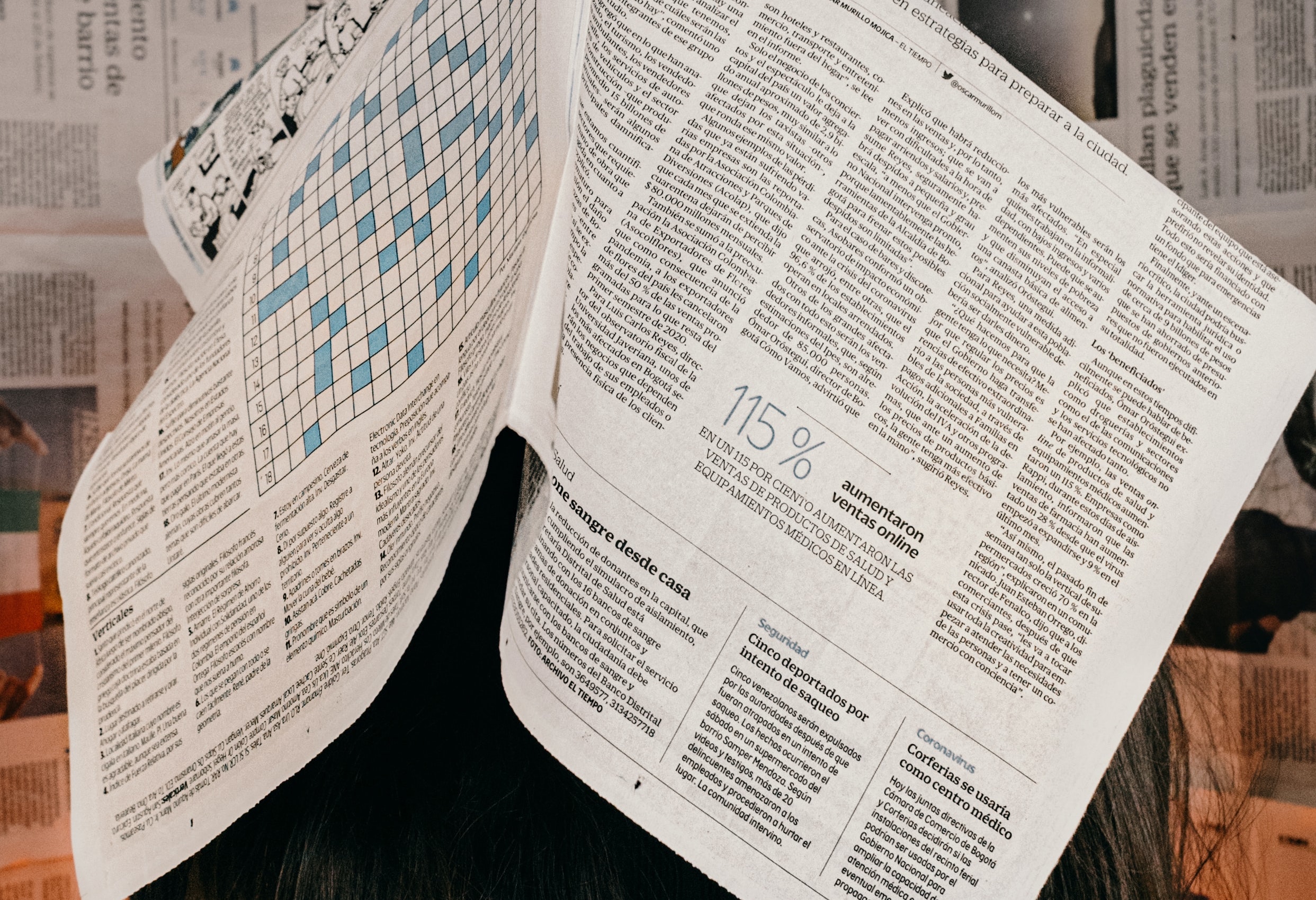
Some subscribers would rather play than sift through the news. Can you blame them?
Article translated by Marine Slavitch — Original version published on the Nieman Lab website on August 10, 2022
The very first time a crossword puzzle grid was published in the press, it was in the December 21, 1913 edition of the New York World. Featured in the newspaper's
Years have passed and the ambition of games pages hasn't changed. They allow newspapers to develop their service-oriented side by delivering more than a daily stream of local or national news. Deep within their pages, readers now find yesterday's sports scores alongside comic strips and, of course, those famous Sudoku grids, crosswords, and word search puzzles. People who aren't interested in reading the news now have a reason to buy the paper too, and this has become the media industry's primary commercial ambition.
Over the past century, and particularly over the last twenty years, publishing executives have tried everything to offer something other than straightforward reporting on their pages. Companies like BuzzFeed and Vox threw themselves headlong into the craze of vertical video on Facebook, which proved to be a very poor decision. Sports network ESPN had restaurants built in Orlando [Florida] and Times Square [New York], until customers admitted they didn't want sportscaster Ron Jaworski following them out of their living room. For its part, Playboy completely gutted its editorial staff, and today, the site redirects to a clothing store that sells shirts and ties emblazoned with the famous rabbit logo. If you're lucky, you might even collect a few NFTs during your visit.
Such are the stakes for an industry that has been slowly eroded by digital technology. The inherent fragility of web media has forced everyone to explore a slew of dubious business models, often with a ridiculously short lifespan. But the solution currently in vogue is delightfully old-fashioned. Everywhere, newspapers, magazines, and websites are developing games sections. In January, Vulture launched its own crossword, "Vulture 10×10," designed to be solved during a coffee break. The New York Times acquired Wordle earlier in the year and continues to add features to its overflowing home page. Their latest gem? Chess games. The New Yorker, meanwhile, made its crosswords a daily feature and launched a trivia game last summer, "Name Drop".
Information was certainly not in short supply in 2022. None of these games pages ever came to replace some lack of political or international news coverage—quite the opposite, in fact. Yet while journalists continue publishing articles about major American divisions, new Covid variants are discovered every day, and the march of world events unfolds at a relentless pace, several media leaders choose to embrace humility. Some subscribers prefer playing games rather than sifting through the news. Can we blame them?
"The first crossword puzzle [in the New York Times] was published in 1942, shortly after the bombing of Pearl Harbor. This tradition of including games in the newspaper as a diversion has existed for eighty years ! "," explains Jonathan Knight, head of the Games section at the Times since 2020. "When we transitioned to digital, we chose to focus more on current events. Now, we're trying to return to that Sunday newspaper experience. "
Knight took an unconventional path into journalism. Before joining the Times, he was vice president of Zynga, the company behind some of the most profitable games ever made (Farmville, Words With Friends, and others). That DNA is everywhere in the Times' Games section, which now brings together a slew of puzzles, with a progress tracker for each one like in the video game Call of Duty. "You've been playing for eight Mondays straight," reads a note attached to my subscription, a sign of my girlfriend's diligent morning habit of solving crosswords.
Knight openly discusses the Times' desire to reach 15 million subscribers by the end of 2027, which can realistically only be achieved by investing in areas outside traditional media boundaries. For example, the Games-only subscription option from the Times, which gives you access to all puzzles for $40 a year, has over a million subscribers. Knight helps the Times break free from the constraints of a newspaper, transforming it into an omnivorous platform that doesn't shy away from unconventional paths. The Times has become a lifestyle brand rather than a newspaper, and that's precisely what allows it to grow.
"Our strategy is to build an essential subscription for curious people who want to understand the world, and that goes beyond just knowing what happened in the world yesterday and reading the news," Knight adds. "This strategy is meeting with great success because the subscription offering puts it front and center. We tell our readers loud and clear: 'You're bound to be interested in some of the products we offer.'"
Knight's findings hold true across the industry. "Subscribers who play crosswords or quizzes every day are more likely to renew their subscription," explains Liz Maynes-Aminzade, Games Editor at the New Yorker. This trend is also reflected in the analytics of all other media companies that have invested in games.
This brings us to a more important point about the boom in games. Liz Maynes-Aminzade notes that the New Yorker has tons of data on how people use its digital games. This data couldn't be gathered when crosswords were made of ink and paper. Its role is crucial given how competitive the Games section has become in the industry lately.
« We now have increasingly more options to choose from. I think it will soon become increasingly important for media outlets to establish specific identities for their Games sections, says Liz Maynes-Aminzade. The bar is rising higher and higher, and classic games won't necessarily attract readers who feel they can find something better elsewhere ».
There will be winners and losers. Journalists tend to be cynical about rescue strategies devised by their editors to reverse declining readership or shrinking advertising budgets. Especially when these strategies materialize as something other than reporting. The fact is that the number of people who want to read news is limited. This reality has spawned countless bad ideas. Expansion followed by contraction, hiring followed by layoffs, pivoting to video, then scaling back that strategy… It can be frustrating to watch your newsroom flail about with crossword puzzles during a crisis.
"We've been solving puzzles in newspapers for 109 years," Liz Maynes-Aminzade reminds us. Today, Games sections don't carry the same nauseating stench that has poisoned so many cruder attempts to make money in media. Look around us: The Ringer is covered with sports betting sponsors. Vice partnered with tobacco giant Philip Morris. The Austin Chronicle faced backlash after publishing an ad for an "Asian brides" service. The outlook is bleak. We could do far worse than having our paychecks funded by crossword puzzles.
« More and more news organizations seem to understand that games can help support their publications as a whole », notes Ms. Maynes-Aminzade. « Games sections have proven their worth. Many magazines and newspapers have featured them for decades. It's hardly controversial to say that crosswords pair well with reading the news. And that doesn't seem likely to change ».
Editor's note
This text is not a word-for-word translation of the original article published on the Nieman Lab website. We have added contextual information, adapted certain expressions, and removed passages containing specific references intended for English-speaking or American readers. We have also chosen to apply inclusive writing rules to this translation, in accordance with the editorial guidelines in effect for all Médianes content.


